Tuesday, July 16, 2013

ARR! muscles in polar coordinates ..

.. or, should i say, cγlindrical cοordinates?
"One of the major discoveries that David Williams brought to light is that force is generated in multiple directions, not just along the long axis of muscle as everyone thinks, but also in the radial direction.
..
The basics of how a muscle generates power remain the same: Filaments of myosin tugging on filaments of actin shorten, or contract, the muscle – but the power doesn’t just come from what’s happening straight up and down the length of the muscle, as has been assumed for 50 years. Instead, University of Washington-led research shows that as muscles bulge, the filaments are drawn apart from each other, the myosin tugs at sharper angles over greater distances, and it’s that action that deserves credit for half the change in muscle force scientists have been measuring.

~ from Biceps bulge, calves curve, 50-year-old assumptions muscled aside @u-dub

courtesy of the university of washington (so don't sue)

despite this being a mechanical and biological process, the funny thing is that the totals are apparently hard to measure:
"“The ability to model in three dimensions and separate the effects of changes in lattice spacing from changes in muscle length wouldn’t even have been possible without the advent of cloud computing in the last 10 years, because it takes ridiculous amounts of computational resources,” Williams said."
it makes me wonder: what basic but subtle aspects of nature have we been missing, all this time?

Monday, July 15, 2013

thoughts, while idle: clarκe's descriptions of geometries.

so i took this past weekend off, joining friends and a special someone to idle away the days in a beach resort town. it was good fun, though i believe now that the idea of a beach is often more attractive than the actual experience.
during those sun-soaked days, i couldn't really concentrate on anything. i tried a little, but having friends around all the time turned even those peaceful periods an hour or two into unusable blocks.

then again, it's a holiday; the point is not to be working!
i did start rendezvοus with rama by arτhur c. clarκe, which made for good episodic reading; the story stretches its telling ..
.. at least until page 100, where i stopped last night..

.. and the plot isn't too intricate that you have to pay attention all the time.

i make it sound simple, but it isn't. the beauty of this book is how it points out the subtlety of human perception towards mathematical possibility.

to give you an idea, the back cover of this book reads:
Rama is a vast alien spacecraft which enters our Solar System. A perfect cylinder some fifty kilometres long, spinning rapidly, Rama is a technological marvel, a mysterious and deeply enigmatic alien artifact. It is Mankind's first visitor from the stars and must be investigated ...
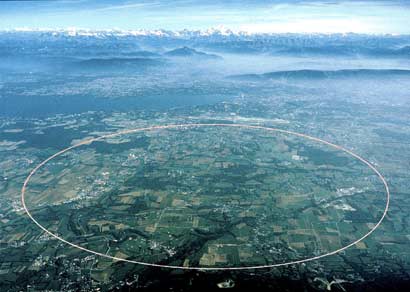
yes, we all know what a cylinder is and we have all (probably) driven as far as 50km on the highway. combining those two bits of information together, however, must make for a rather unique sight. even the large hadrοn collider at CERN is only 27km in circumference, and i don't know if anyone has ever caught the entire thing within a single frame of vision ..!


anyway, here is an excerpt from p. 74:
"Because they were now standing on the edge of a fifty-metre cliff, it was possible for the first time to appreciate the curvature of Rama. But no one had ever seen a frozen lake bent upwards into a cylindrical surface; that was distinctly unsettling, and the eye did its best to find some other interpretation. It seemed to Dr Ernst, who had once made a study of visual illusions, that half the time she was really looking at a horizontally curving bay, not a surface that soared up into the sky. It required a deliberate effort of will to accept the fantastic truth."
moreover, clarκe does an excellent job of suggesting that, though space and its contents may be absolute, our perspectives of it can be rather relative:

from p. 42:
"And now, Karl Mercer told himself, I have to make my first decision. Am I going up that ladder, or down it?

The question was not a trivial one. They were still essentially in zero gravity, and the brain could select any reference system it pleased. By a simple effort of will, Mercer could convince himself that he was looking out across a horizontal plain [1], or up the face of a vertical wall, or over the edge of a sheer cliff. Not a few astronauts had experienced grave psychological problems by choosing the wrong coordinates when they started on a complicated job."
[1] the first two times i read this paragraph, i thought that the word was 'plane' and not 'plain.' (-:

Friday, July 12, 2013

the how is done, but what about the why ..?

so i've been working systematically on the same problem all this week, and i think i've come up with a good proof. in that sense, it's been a satisfying week.

this morning, though, i looked at the result that the proof implies .. and debated whether it is worth publishing.

to its credit, the topic is mainly about fractals but not exactly the self-similar kind. nevertheless the diagrams should be pretty to look at.


it's not too technical either. most of the work lies in building the right lιpschitz functions, actually.

then again, it's about these objects called (metrιc) derivatiοns that come up in analysιs and geοmetry of metrιc-measure spaces. i've been working with these things for a while, but my feeling is that few people care about them .. or about metrιc spaces in general.

maybe i should advertise it as a gmτ result, of some kind. one corollary is that certain kinds of fractals cannot arise as flat chaιns (in the sense of whitηey), yet their weak tangeηts are flat.
i don't know how interesting that is in gmτ, though;

maybe i should just shelve the result for now, and think about something else. for one thing, i promised one newly-met colleague that i'll think about systems of ρde's, next week!

Thursday, July 11, 2013

à la pοincaré: the 4-hour day.

tuesday, 9 july 2013 @ 11:44 EEST:

my new plan: i'll concentrate on being as productive as i can, but specifically during the hours that i know that i am usually productive (even if it means that i am working far fewer hours than i usually do).

this includes first thing in the morning ..
today was already productive:
i constructed a whole class of counter-examples!

.. and probably late afternoon into early evening, just before i usually go running or join friends for climbing, actually.

odd: why would the "bookend" times be the most productive?

maybe i should also keep a "journal" of what i did during those hours, and how long it took? this is in reaction to how ineffective my to-do lists are: they are always overloaded and i can never check everything off, which eventually gets depressing.

the tricky thing is how to be productive in the hours in between. one possibility is that if i'm going to waste time, then i may as well enjoy myself, like reading novels or blogging or taking photos of the city, but another possibility is to fill it with drudgery, such as writing a review for this article that is 4 months late .. etc.

on the other hand, maybe a few hours of real work is enough; i mean if it was good enough for poincare .. [0]


wednesday, 10 july 2013 @ 08:38 EEST:

ups and downs again:
two days ago i knew what worked .. or at least, i thought i did;

yesterday i was convinced that a colleague's "conjecture" [1] is false and even had a rough proof in mind,

but just now i found a gap in my argument,
so i'll spend today working on a patch.
despite having been privately wrong [2] this has been a pretty exciting week, mathematically speaking. the uncertainty of it all is .. not intoxicating, but like a high. not knowing what exactly is true is all the more motivation to figuring out what it could be .. especially if it keeps on switching, due to increased effort.

so work is fun again and i can obsess about it with new abandon.


[0] to be fair, i wonder what poincare would consider "work." my guess is that the man had high standards, so a lot of things he wouldn't consider work, i would!

[1] i like to reserve the word 'conjecture' for those unproven claims that are particularly nontrivial .. and no, i don't have a definition of nontrivial, but just a sufficient condition: if, by telling someone related to your field of the basic notions, by stating the problem, and by showing why it is hard or what it would imply, that that someone become interested, then it's nontrivial.

[2] 'privately wrong' is doing something stupid in the privacy of your own workspace. 'publicly wrong' is having many people know about it. i've been both, and the former is very, very much preferable to the latter.

Tuesday, July 09, 2013

ARR! strange occurrences in science

// initially written: last week (or before)
ok: so what exactly is a measurement, then?
"Just like position and momentum, quantum theory predicts that the polarization along two different axes cannot simultaneously be known with certainty (see Nature). The team adopted a strategy in which the polarization is initially probed using a series of ‘weak’ measurements — detections that barely disturb the system but must be repeated several times to record the same information that a single ‘strong’ measurement can detect. They found that, on average, the polarization measurements disturbed the system by only about half as much as Heisenberg’s original formulation of the uncertainty principle dictates."

~ from "Proof mooted for quantum uncertainty" @nature
speaking of science, maybe this explanation of mercury's liquid state is well-known .. but admittedly, i was ignorant of it.
"Relativity states that objects get heavier the faster they move. In atoms, the velocity of the innermost electrons is related to the nuclear charge. The larger the nucleus gets the greater the electrostatic attraction and the faster the electrons have to move to avoid falling into it. So, as you go down the periodic table these 1s electrons get faster and faster, and therefore heavier, causing the radius of the atom to shrink. This stabilises some orbitals, which also have a relativistic nature of their own, while destabilising others. This interplay means that for heavy elements like mercury and gold, the outer electrons are stabilised. In mercury’s case, instead of forming bonds between neighbouring mercury atoms, the electrons stay associated with their own nuclei, and weaker interatomic forces such as van der Waals bonds hold the atoms together."

~ from "Relativity behind mercury's liquidity" @rsc


lastly .. judging from how i wrote this post, it's safe to assume that those monday roundups aren't returning anytime soon.

let me clarify: i still think that rounding up articles is a good idea, but a weekly time constraint feels slightly artificial to me. i'd much rather collect items with a common theme and let the ideas percolate into something coherent. (i don't know if i'll do this weekly; it really depends on how much interesting stuff appears on the blogosphere.)

that said, i'm open to taking requests;
if you want my opinion on a topical article, then send me the link.

that said, the MoAR label will become just ARR!, where AR refers to ARticle, R to Roundup, and ! to indicate that i have an opinion!

Monday, July 08, 2013

off the cuff: snippets before the weekend.

// snippets from thursday, 4 july 2013

i'm trying to unlock a door, figure out blueprints for objects that, in their full generality and obscurity, requires believing in statements like the axiοm of choice and their implications [1]. for the right skeleton i've recast someone else's conjecture for bones and soft cartiliage.

i have examples. i know that these things exist, at least in crude forms, but how sophisticated must the designs really be?


i don't know if unlock or build is the right word, mathematically speaking. i don't know what the right word could be.

all i know is that i'm stumped at the mathematics, and all i can do now is discuss the frustration of those mathematics.


[1] apparently "axiom of choice" is also the name of a band.

Monday, July 01, 2013

unfocused .. (updated)

maybe i should take a vacation: a short one, maybe a week.

i haven't been able to focus for a while. today i was in the office and rather than sticking to a list of things that i really should do, i spun the same ideas on the same problem that i've failed to solve for .. well, years.

..

it's one of those transitional times in my life again:
1. in six weeks i'll start a new job in the states, one that could be for life .. that is, if they like me enough;

2. i recently solved an open problem that's plagued me from the latter years of my ph.d. it was the kind of problem that if i had a spare day, then i'd just attack it with any idea i had .. even if it meant that the day would be lost to compulsion, folly, and frustration.
so i can't seem to get excited about any new projects. there's plenty of things to do, of course, but .. i can't convince myself to do anything.

sometimes i'll catch myself staring through the window, not thinking about anything in particular.

// added 2 july 2013 @ 03:46 EST
so perhaps i spoke too soon:

when i woke up today and made coffee, i decided not to attack the problem again but instead, work out a related formula that has stumped me before.

it turns out that it follows pretty easily from basic principles .. at least, easily after a good night's sleep (and/or subconscious hacking).

now that i think about it: it would make sense that i had proven it before, forgotten it, and just now re-discovered it. i don't know, i can't remember, and my notes are not archived well enough for me to check it readily.

[shrugs]

well, at least it's true. it doesn't solve that aforementioned problem, of course, but it does narrow the gap so that there are fewer things to try.

..

related to all of this, i keep forgetting about the happy clarity that mornings can provide. let me make this clear: though it might be nice to be part of the 5am club, i'm happy enough enjoying the evenings and getting a few hours in the morning before heading to the office. (-:

Saturday, June 29, 2013

sometimes maths is just about numbers.

well, i've been dating this girl ..


this morning we were talking about work. she happened to have a few blueprints(?) in her bag of what her firm was doing and how many simultaneous processes the proposed factory would be using.

it seemed very complicated to me .. like an electric circuit diagram on steroids!

then an idea came to mind .. maybe it can be my turn! .. so on her computer i showed her one of my preprints. her brow furrowed.
the basic idea's isn't that bad, i tell her.

for things that behave like mass distributions, the small-scale behavior can sometimes determine the large-scale. if, for example, there aren't enough directions when you zoom in at any given point, then the mass has to be distributed either like dust [1] or be restricted to fewer dimensions, like a line in space.

then there was a brief pause.

wait, she said, it takes 27 pages to explain that?!?

i shrugged.
well, the latest version is now 29 pages [2].
we then talked about how, at a certain point, maths no longer consists of calculating things .. not exactly, anyway.


[1] i.e. a fractal with non-integer hausdοrff dimensiοn, but not necessarily self-simιlar. at the time i was thinking about purely unrectifιable subsets of the plane.

[2] thinking about it, maybe i should have said something like: well, define "dust" ..?

*NOTE* the new label ½ × 2 is meant to tag those (few) posts which are about how mathematics, for inexplicable reasons, relates to my relationships. the idea is: once you've been with someone long enough, you are no longer 1 person. rather, you are one-half of two people. (-:

Friday, June 28, 2013

backlog.

i think i must be the world's worst research collaborator. despite good intentions, i never seem to get back to my co-authors in any reasonable time-frame.

[sighs]

also, forget that bit about a lack of hurry;
i'm starting to think that i have too many projects.

Monday, June 24, 2013

MoAR #25: inter alia, the human kind of asymmetry.

well, it's been 25 of these roundups. my guess, as before, is that you readers can probably do your own news searches, and with greater effectiveness to fit your own tastes.

that said, i'll still be posting articles i find interesting, but just not in roundup form anymore.


1. not the isomorphism that i expected, but ..

.. apparently some processes are universal, whether organic or digital:
"On the surface, ants and the Internet don't seem to have much in common. But two Stanford researchers have discovered that a species of harvester ants determine how many foragers to send out of the nest in much the same way that Internet protocols discover how much bandwidth is available for the transfer of data."

~ from "Stanford researchers discover the 'anternet'" @stanford.edu

2. the 'flame' kind of war

when i read this excerpt, the first thing which came to mind was:

why is this even a question? we haven't stopped teaching spelling, grammar, and vocabulary to students, just because they now have word processors, right?
The standard algorithms should be avoided because, reformists claim, mastering them is a merely mechanical exercise that threatens individual growth. The idea is that competence with algorithms can be substituted for by the use of calculators, and reformists often call for training students in the use of calculators as early as first or second grade.
..
That the use of standard algorithms isn’t merely mechanical is not by itself a reason to teach them. It is important to teach them because, as we already noted, they are also the most elegant and powerful methods for specific operations. This means that they are our best representations of connections among mathematical concepts.


~ from "The Faulty Logic of the ‘Math Wars’" @nyt
admittedly, though, a lot of times i just opine when i feel like it, and drop things when i don't ..
These professors maintain that college-level work requires ready and effortless competence with the standard algorithms and that the student who needs to ponder fractions — or is dependent on a calculator — is simply not prepared for college math. They express outrage and bafflement that so much American math education policy is set by people with no special knowledge of the discipline.
to be honest, i don't know who really is in charge of mathematics educational policy, but i strongly suspect that most college faculty opt out of any involvement with it. call it a professional opportunity cost: unless you rake in a lot of external funding from it, there's not a lot of incentive to work on educational problems instead of research ones.


3. wait .. what?

there are plenty of shocking items of news in the world lately, like:
This year, a pilot scheme was introduced to enforce the rules.
..
When students at the No.3 high school in Zhongxiang arrived to sit their exams this month, they were dismayed to find that they would be supervised by 54 randomly selected external invigilators.
..
By late afternoon, the invigilators were trapped as students pelted the windows with rocks. Outside, more than 2000 people had gathered, smashing cars and chanting: ''We want fairness. There is no fairness if you do not let us cheat.''
..
The protesters claim cheating is endemic in China and that sitting the exams without help puts their children at a disadvantage.


~ from "Chinese students and families fight for the right to cheat their exams" @smh
the last excerpt warrants interpretation; i think the protest is specific to why their city was chosen for enforcement, instead of other cities. the article goes on to point out that last year, the education department received 99 identical exam papers .. but then again, there's no comparison as to how other cities' stats stack up.

imagine, for example, if other cities had been recorded at 500+ identical copies.

considering the population of certain cities in china, that's no longer a large number of students;
as a result, without additional data i wouldn't rule out political favoritism yet ..

nonetheless, this kind of news is alarming. i've heard that eastern culture favors the group over the individual, and that the socioeconomic inequity in india and china is huge, but .. really?

well, moving towards a more abstract direction ..
The researchers are trying to avoid a situation where we outsmart ourselves, and create a system that can in turn invent its own technologies, which could "steamroll" humanity – not because it’s evil, but simply because we couldn’t foresee the long-term ramifications of how we programmed it.
..
"Think how it might be to compete for resources with the dominant species," Price says. "Take gorillas, for example – the reason they’re becoming extinct isn’t because humans are actively hostile towards them, but because we control the environment in a way that suits us, but is detrimental to their survival.


~ from "The men trying to save us from the machines" @pcpro
considering how well we understand turιng machines yet still face computer crashes regularly, in this day and age, this might not be a bad approach in general. it would be rather .. depressing if all of humanity were swept away, due to a computer glitch!

to a lesser, more realistic extent: the access and operations for my savings and checking accounts are probably automated within some banking computer system. if enough errors pile up, then .. [cringes].


4. to humans, does time lack symmetry?

i would have thought that we humans are good at accounting for symmetry. then again, i'd probably also fall prey to this ..
But when asked to predict what their personalities and tastes would be like in 10 years, people of all ages consistently played down the potential changes ahead.
..
Thus, the typical 20-year-old woman’s predictions for her next decade were not nearly as radical as the typical 30-year-old woman’s recollection of how much she had changed in her 20s. This sort of discrepancy persisted among respondents all the way into their 60s.


~ from "Why You Won’t Be the Person You Expect to Be" @nyt
the main mechanism might be memory, which resides clearly in the past, not the present, and is arguably inherently faulty.

anyway, towards a more familiar setting .. here's a thought that makes sense, but never came to mind when i was teaching:
You would think that since you have been a student and survived you would be able to recognize their misconceptions and guide them to enlightenment. But even if you could remember what it was like to be a student, that moment for you was characterized by a similar hit-and-run-don’t-leave-a-calling-card confusion.

Everybody gets hit by the bus, everybody gets knocked out, everybody survives, but nobody remembers what they got hit by. So you can’t tell them what to watch out for. Teachers can’t understand their students’ confusion even though they once experienced the exact same confusion!


~ from "Teach Like You Don’t Know" @desmondrawls
a good point, but the comparison (i.e. hit-&-run) as well as the phenomenon seems a bit forced. it's not like the act of learning is some version of achilles and the tortoise, right!

maybe the point is the instability of learning. everything is fine for students, as long as they're following diligently and carefully .. but once they trip up, their confusion can be utter confusion. /-:


5. lastly, a bit about online education.

i know that i've ranted on and on about MOOCs a lot, but this is the first article that mentions any behind-the-scenes kind of details:
So, what hasn’t gone as planned? Certainly some things do not translate from a traditional classroom course to a MOOC. Our team realized quickly that we needed to do a better job cross-linking material on the course site. For example, if we mention the syllabus, we must link to it. Some students, we have learned, want a great deal of guidance.
..
We also underestimated the misunderstandings that can arise from idiomatic and discipline-specific language. We began the course by asking students to complete a Personal Benchmark Statement, only to discover that we needed to provide a definition of “benchmark.” A longer glossary of terms became a featured part of our site.


~ from "Inside a MOOC in Progress" @the_chronicle
interesting: in terms of the latter gaffe, in a multivariable calculus class it once took me a week to realise that i'd been calling a $\partial$ a 'del' without actually having told the class of the pronunciation.

(for the record, it was one very brave student who asked in the middle of class; subsequently a collective 'oh' erupted through the lecture hall.)