Showing posts with label visual. Show all posts
Showing posts with label visual. Show all posts
Wednesday, July 24, 2013
Tuesday, July 23, 2013
quick post: round&round, and other visualisations (*UPDATED*)
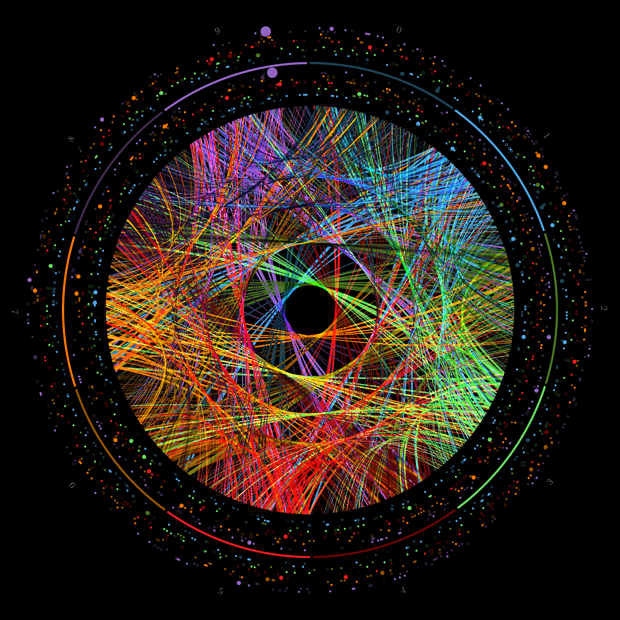
apparently, this is π;
(courtesy of mkweb).

a realisation of a strange attractor
(courtesy of chaotic atmospheres)

a somewhat self-similar sculpture by carl jara (via thisiscolossal)

i immediately wondered what the π1 of this sculpture was ..(-:
(art by henrique oliveira, via thisiscolossal)
lastly, something more "real" ..?

this is apparently a visualisation of what wifi networks would look like.
(photos by nickolay lamm @mydeals)
Thursday, July 18, 2013

Monday, July 15, 2013
thoughts, while idle: clarκe's descriptions of geometries.
so i took this past weekend off, joining friends and a special someone to idle away the days in a beach resort town. it was good fun, though i believe now that the idea of a beach is often more attractive than the actual experience.
during those sun-soaked days, i couldn't really concentrate on anything. i tried a little, but having friends around all the time turned even those peaceful periods an hour or two into unusable blocks.i did start rendezvοus with rama by arτhur c. clarκe, which made for good episodic reading; the story stretches its telling ..
then again, it's a holiday; the point is not to be working!
.. at least until page 100, where i stopped last night..
.. and the plot isn't too intricate that you have to pay attention all the time.
i make it sound simple, but it isn't. the beauty of this book is how it points out the subtlety of human perception towards mathematical possibility.
to give you an idea, the back cover of this book reads:
i make it sound simple, but it isn't. the beauty of this book is how it points out the subtlety of human perception towards mathematical possibility.
to give you an idea, the back cover of this book reads:
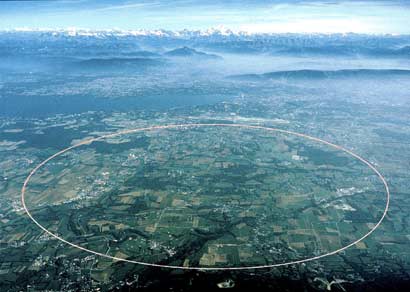
Rama is a vast alien spacecraft which enters our Solar System. A perfect cylinder some fifty kilometres long, spinning rapidly, Rama is a technological marvel, a mysterious and deeply enigmatic alien artifact. It is Mankind's first visitor from the stars and must be investigated ...yes, we all know what a cylinder is and we have all (probably) driven as far as 50km on the highway. combining those two bits of information together, however, must make for a rather unique sight. even the large hadrοn collider at CERN is only 27km in circumference, and i don't know if anyone has ever caught the entire thing within a single frame of vision ..!
anyway, here is an excerpt from p. 74:
from p. 42:
"Because they were now standing on the edge of a fifty-metre cliff, it was possible for the first time to appreciate the curvature of Rama. But no one had ever seen a frozen lake bent upwards into a cylindrical surface; that was distinctly unsettling, and the eye did its best to find some other interpretation. It seemed to Dr Ernst, who had once made a study of visual illusions, that half the time she was really looking at a horizontally curving bay, not a surface that soared up into the sky. It required a deliberate effort of will to accept the fantastic truth."moreover, clarκe does an excellent job of suggesting that, though space and its contents may be absolute, our perspectives of it can be rather relative:
from p. 42:
"And now, Karl Mercer told himself, I have to make my first decision. Am I going up that ladder, or down it?[1] the first two times i read this paragraph, i thought that the word was 'plane' and not 'plain.' (-:
The question was not a trivial one. They were still essentially in zero gravity, and the brain could select any reference system it pleased. By a simple effort of will, Mercer could convince himself that he was looking out across a horizontal plain [1], or up the face of a vertical wall, or over the edge of a sheer cliff. Not a few astronauts had experienced grave psychological problems by choosing the wrong coordinates when they started on a complicated job."
Wednesday, June 19, 2013
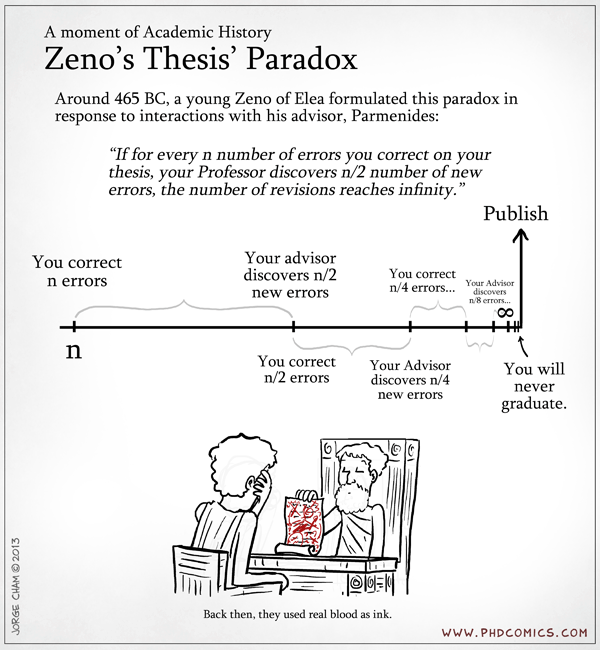
some "comic" relief.
as you can imagine, i'm not feeling very productive today. (-:

on a related note, i haven't really been following ρhdcomics much, anymore. it's getting to the point where they become painful reminders of how hard graduate school was.
hard is a relative term, of course. maybe it really was hard .. it felt like that to me, anyway .. and certainly postdoc life here in finland feels far easier, or if anything, freer.
hard is a relative term, of course. maybe it really was hard .. it felt like that to me, anyway .. and certainly postdoc life here in finland feels far easier, or if anything, freer.
Monday, June 10, 2013
MoAR: no news, just snapshots (UPDATED)
i've read enough about NSΛ wiretapping and whistleblowing this week, and so might you. instead, what i thought i'd do is share what news i could find in photographs ..
#1: an oddity, just for fun. i wouldn't call this a "perfect sphere" .. but roughly, it does look like a ball:
#2: something more mathematically designed. this next one is an ingenious combination of self-similar-like fractals, but with a more human element in mind:
#3: the applied kinds of maths. as for something more quantitative ..
also: The geography of Tweets: This image uses all of the geo-tagged Tweets since 2009 — billions of them. (Every dot is a Tweet, and the color is the Tweet count.)
.. and, if you will, one of those new fangled moving images:
#4: some rather old maths homework: Two math-notebook pages recently authenticated as belonging to Abraham Lincoln suggest the 16th president, who was known to downplay his formal education, may have spent more time in school than usually thought.
#5: okay, maybe a little bit of news.. but i'll restrict them to headlines and one-sentence excerpts. those headlines that are self-explanatory or sound inherently interesting (see below) won't even have an excerpt at all.
from "Coursera Jumps the Shark" @higheredstrategy:
from "The Real Reason Cities Are Centers of Innovation" @theatlantic:
"'Cheating' Can Be An Effective Learning Strategy" @npr:13.7.
"Fear of Death Makes People Into Believers (of Science)" @scimag.
from "What can genes do?" @aeommag:
.. okay, fine: i couldn't resist mentioning the wiretapping thing, if only once; this bit of news just unnerves me ..
#1: an oddity, just for fun. i wouldn't call this a "perfect sphere" .. but roughly, it does look like a ball:

#2: something more mathematically designed. this next one is an ingenious combination of self-similar-like fractals, but with a more human element in mind:

#3: the applied kinds of maths. as for something more quantitative ..

also: The geography of Tweets: This image uses all of the geo-tagged Tweets since 2009 — billions of them. (Every dot is a Tweet, and the color is the Tweet count.)

.. and, if you will, one of those new fangled moving images:
"As the speaker is cycled through various frequencies the sand naturally gravitates to the area where the least amount of vibration occurs causing fascinating geometric patterns to emerge. There’s actually a mathematical law that determines how each shape will form, the higher the frequency the more complex the pattern."
from brusspup @thisiscolossal
#4: some rather old maths homework: Two math-notebook pages recently authenticated as belonging to Abraham Lincoln suggest the 16th president, who was known to downplay his formal education, may have spent more time in school than usually thought.

#5: okay, maybe a little bit of news.. but i'll restrict them to headlines and one-sentence excerpts. those headlines that are self-explanatory or sound inherently interesting (see below) won't even have an excerpt at all.
from "Coursera Jumps the Shark" @higheredstrategy:
Yesterday, Coursera did a weird strategy about-face by announcing that, rather than competing with public colleges, it’s going to start competing with Blackboard instead."Spain builds submarine 70 tons too heavy after putting a decimal in the wrong place" @canada.com.
from "The Real Reason Cities Are Centers of Innovation" @theatlantic:
As they grow in population, all kinds of positive outcomes like patents and GDP and innovation (and negative ones like STDs and crime) grow at an exponential factor of 1.1 to 1.3.from "the limits of physics" @aeonmag:
Are the waves physically real, or are they just mathematical representations of probability distributions?"Atomic Bombs Help Solve Brain Mystery" @ scinow.
"'Cheating' Can Be An Effective Learning Strategy" @npr:13.7.
"Fear of Death Makes People Into Believers (of Science)" @scimag.
from "What can genes do?" @aeommag:
the reason is that the causation involved is so complex and deeply probabilistic that it is, in effect, unpredictable even if we were to try to enumerate all the contributing factors.from "Technical Notes on the NSA's Prism Program" @lahiri.me:
Link prediction is a well-studied research problem where, given a graph, the goal is to predict links that are "missing" in some sense.
.. okay, fine: i couldn't resist mentioning the wiretapping thing, if only once; this bit of news just unnerves me ..
Saturday, June 08, 2013
#1300: chalkboard post.
from a few days ago:

(in other news, this is my 1300th post on this blog; time flies, doesn't it?)
(in other news, this is my 1300th post on this blog; time flies, doesn't it?)
Monday, June 03, 2013
MoAR: assorted bits.
maths follows art.
i've heard the claim before that for some phenomena, physicists "knew" them long before mathematicians did.
that choice of wording has always bothered me, because it suggests that (experimental) physicists are somehow "smarter" than mathematicians .. as if the disciplines can really be compared. it's a difference in methodology, or for that matter, epistemology:
scientific conclusions are only as accurate as the data you can physically observe and measure within the scope of the problem. on the other hand, if a mathematician proves that something is true then (s)he is simultaneously asserting that a countless number of pathologies are impossible.
at any rate .. with respect to the same abuse of language, sometimes artists are "smarter" than mathematicians:
" The same is true in visual arts. Vincent van Gogh’s later paintings had all sorts of swirling, churning patterns in the sky — clouds and stars that he painted as if they were whirlpools of air and light. And, it turns out, that’s what they were! In 2006, physicists compared van Gogh’s patterns of turbulence with the mathematical formula for turbulence in liquids. The paintings date to the 1880s. The mathematical formula dates to the 1930s. Yet van Gogh’s turbulence in the sky provided an almost identical match for turbulence in liquid.the last paragraph gives me pause: to what extent is this phenomenon unique, really? the only way to check this if most drip paintings do not obey a self-similar pattern; otherwise pollock wouldn't really be unique in this sense, would he?
Art sometimes precedes scientific analysis, and the relationship can go the other way too: Scientists can use art to understand math.
Even the seemingly random splashes of paint that Jackson Pollock dripped onto his canvases show that he had an intuitive sense of patterns in nature. In the 1990s, an Australian physicist, Richard Taylor, found that the paintings followed the mathematics of fractal geometry — a series of identical patterns at different scales, like nesting Russian dolls. The paintings date from the 1940s and 1950s. Fractal geometry dates from the 1970s. That same physicist discovered that he could even tell the difference between a genuine Pollock and a forgery by examining the work for fractal patterns."
~ from "How an Entirely New, Autistic Way of Thinking Powers Silicon Valley" @wired
so i'm not alone in my confirmation bias.
this reminds me of something from a previous roundup, but better stated and not just about the job search.
" Survivorship bias also flash-freezes your brain into a state of ignorance from which you believe success is more common than it truly is and therefore you leap to the conclusion that it also must be easier to obtain. You develop a completely inaccurate assessment of reality thanks to a prejudice that grants the tiny number of survivors the privilege of representing the much larger group to which they originally belonged."
~ from "Survivorship Bias" @youarenotsosmart.com
(this excerpt is a lot more interesting, once you learn the title of the article.)
i like this article, if only because it hints at why we mathematicians study things that "don't really exist" .. at least in everyday physical reality.
" What these theories do share is a certain level of rigor. Rather than being arbitrary, they involve precisely defined conditions that collectively give rise to interesting properties. While a theory in the theoretical physics sense isn't “true” in that it doesn’t describe the real world, it is “true” in that two researchers will agree on the theory’s properties. This allows interested parties to build off each other’s work. "
~ from "Earning a PhD by studying a theory that we know is wrong" @arstechnica
lastly, some cool links!
first, some time-dependent distortion and translation on a space that is close to a sphere:

secondly, the geometric consequence of a harmonic series:
" With no wind, a lot of time, and a ridiculous amount of patience, it’s possible to make a tower like the one [below].
(Vertical axis not to scale).
The overhang for 52 cards is approximately 2.269 times the width of one card. Not bad. "
~ from "How far can you overhang blocks?" @datagenetics

Sunday, April 28, 2013
MoAR: bad news, questionable news, and ..
it's been a good week:
i'm eating well,
i'm more tanned than i've been in a while,
i meet good friends every day ..
.. and i think a collaborator and i have hammered out the basics for a short new paper .. or rather, a note. it will be about fractals; maybe i'll write about it sometime.
that said, this idyll bliss won't last. tomorrow begins a week-long conference and after that i'll be gone again. when i was younger, i'd despair of these endings. growing older now, i start to wonder if the good times are necessarily short with premature ends.
this might explain, then, why i seemed to stumble onto more bad news than good, this week ..
the second paragraph below makes me cringe. cheating has some terrible (and unexpected) consequences.
i remember being told by my counselor in high school that one should join various clubs, sports teams, and organisations (including charity work) because it looks good in college applications.
i don't know if the following excerpt is true or not. without firsthand accounts of university deans and other higher-ups from that era, it's hard to justify the suggested causality of events. (there's also the problem of presentism, of course.)
admittedly, i've thought about the same ethical dilemma before. fortunately for cafe owners, i seem unable to concentrate at a cafe longer than 2 hours, which means more turnover for them.
strange things happen when we digitise them and set them in the grand scale of the internet. despite connecting us to more people, social media may have made us all lonelier. it would be equally strange if the same thing would happen betwen teachers and students ..
the next article isn't so much about questionable behavior as it is about peculiar choices. (i see the reasons behind the instructor's choices, but i wouldn't do it myself .. partly because i don't see how pure maths could fit the same model.)
lastly: imagine that, instead of time or distance, we could parametrise curves based on income?


actually, none of the excerpts below are inherently "good." they're just bits of news that don't depress me or cause me malaise.
for example, this is an excerpt from a pretty good expositional article:
i'm eating well,
i'm more tanned than i've been in a while,
i meet good friends every day ..
.. and i think a collaborator and i have hammered out the basics for a short new paper .. or rather, a note. it will be about fractals; maybe i'll write about it sometime.
then again, experience tells me that nothing i do is ever short.
[sighs]
[sighs]
that said, this idyll bliss won't last. tomorrow begins a week-long conference and after that i'll be gone again. when i was younger, i'd despair of these endings. growing older now, i start to wonder if the good times are necessarily short with premature ends.
this might explain, then, why i seemed to stumble onto more bad news than good, this week ..
first, the bad news ..
the second paragraph below makes me cringe. cheating has some terrible (and unexpected) consequences.
" Now, looking around during rush hour, as people streamed on and off the platforms, Stapel could not find a location that matched the conditions described in his experiment. “No, Diederik, this is ridiculous,” he told himself at last. “You really need to give it up.”
..
The scrutiny was meant not only to clean up the scientific record but also to establish whether any of Stapel’s co-authors, including more than 20 Ph.D. students he supervised, shared any of the blame. It was already evident that many of the doctoral dissertations he oversaw were based on his fabricated data.
..
".. Science is of course about discovery, about digging to discover the truth. But it is also communication, persuasion, marketing. I am a salesman. I am on the road. People are on the road with their talk. With the same talk. It’s like a circus."
~ from "The Mind of a Con Man" @nyt
i remember being told by my counselor in high school that one should join various clubs, sports teams, and organisations (including charity work) because it looks good in college applications.
i don't know if the following excerpt is true or not. without firsthand accounts of university deans and other higher-ups from that era, it's hard to justify the suggested causality of events. (there's also the problem of presentism, of course.)
" "Holistic admissions criteria emerged at Ivy League schools in the early 20th century and were almost immediately twisted for virulently anti-semitic purposes. Until the 1920s, students took an admissions test and those that did well on the test were admitted to the colleges “almost entirely on the basis of academic criteria.” This resulted in lots of Jewish men on the campus of Harvard, Princeton, and Yale.
It’s around this time that Ivy League schools switched from a strictly quantitative system of test scores to a more subjective, holistic approach. The holistic approach was used to squelch diversity and the number of Jews in American universities then plummeted.""
~ from "Do Elite Colleges Discriminate Against Asians?" @priceonomics
.. next, some questionable news ..
admittedly, i've thought about the same ethical dilemma before. fortunately for cafe owners, i seem unable to concentrate at a cafe longer than 2 hours, which means more turnover for them.
"I’m sure there are people who spend time like me and spend money more generously. Buying peppermint mochas or pumpkin spice lattes plus a pastry sounds delicious and seems like it buys you as much time as you'd like. Is the time spent at the coffee shop balanced out by what you've purchased at the coffee shop?"
~ from "The ethical coffee shop freelancer" @medium
strange things happen when we digitise them and set them in the grand scale of the internet. despite connecting us to more people, social media may have made us all lonelier. it would be equally strange if the same thing would happen betwen teachers and students ..
"It creates a strange paradox: these professors are simultaneously the most and least accessible teachers in history. And it’s not the only tension inherent in MOOCs."
~ from "Two Cheers for Web U!" @nyt
the next article isn't so much about questionable behavior as it is about peculiar choices. (i see the reasons behind the instructor's choices, but i wouldn't do it myself .. partly because i don't see how pure maths could fit the same model.)
"A week before the test, I told my class that the Game Theory exam would be insanely hard—far harder than any that had established my rep as a hard prof. But as recompense, for this one time only, students could cheat. They could bring and use anything or anyone they liked, including animal behavior experts. (Richard Dawkins in town? Bring him!) They could surf the Web. They could talk to each other or call friends who’d taken the course before. They could offer me bribes. (I wouldn’t take them, but neither would I report it to the dean.) Only violations of state or federal criminal law such as kidnapping my dog, blackmail, or threats of violence were out of bounds.
Gasps filled the room. The students sputtered. They fretted. This must be a joke. I couldn’t possibly mean it. What, they asked, is the catch?
“None,” I replied. “You are UCLA students. The brightest of the bright. Let’s see what you can accomplish when you have no restrictions and the only thing that matters is getting the best answer possible.”" "
~ from " Why I Let My Students Cheat On Their Game Theory Exam " @popsci
lastly: imagine that, instead of time or distance, we could parametrise curves based on income?
~ from "INEQUALITY AND NEW YORK’S SUBWAY" @newyorker
.. and now, the good news.
actually, none of the excerpts below are inherently "good." they're just bits of news that don't depress me or cause me malaise.
for example, this is an excerpt from a pretty good expositional article:
"Yet for the most part, complex numbers are treated as an inconvenience. Because they are inherently multi-dimensional, they defy our attempts to visualize them easily. Graphs describing complex math are usually simplified schematics that only hint at what's going on underneath. Because our brains don't do more than 3D natively, we can glimpse only slices of the hyperspaces necessary to put them on full display.".. and that's about it for "good" news, this week. 7-:
~ from "how to fold a julia fractal" @acko
Thursday, April 04, 2013
the worknight spirals to its end.
i was $\LaTeX$ing for most of the evening, but now i'm just tired .. yet not tired enough to crash into bed, yet. it's times like this when i'm glad that the internet is full of diversions: a wonderful interpolation between the rigors of work and the decadence of play.
just now i've discovered the photography of one fred izquierdο, and his shots are rather aesthetic in their geometry:


i can't tell if these shots are inherently hypnotic or not .. but no matter. (maybe it's time to call it a night.)
just now i've discovered the photography of one fred izquierdο, and his shots are rather aesthetic in their geometry:
i can't tell if these shots are inherently hypnotic or not .. but no matter. (maybe it's time to call it a night.)
Monday, March 25, 2013
MoAR: bare-bones, this week.
this week's roundup is a bit sparse, without too much deep commentary. i guess i've been distracted, if not busy, with writing and editing a manuscript or two, and havne't had too much spare brainpower to ponder meaningful opinions to these things i've read.
i should stop posting article excerpts about this topic. the phenomenon is in full swing, but it's too early to conclude anything about it. for instance, there is no first generation of MOOC college "graduates" yet, so we don't know how stable the framework is.
it's also not clear to me if the objectives for MOOCs have been fully made clear and compatible to the public. as for the faculty, however ..
well, if number theory can encrypt data, then i suppose that abstract algebra can improve things further ..
first, the excerpt ..
so despite the motives for this kind of conference, it kind of makes sense. it's not like one's ph.d. supervisor would have a lot of information about non-academic jobs, because (s)he's spent an entire career gearing for the opposite.
part of me hopes that the creative process will always remain a mystery, with a level of randomness and experience that makes it fundamentally human. on the other hand, if someone could give me a recipe for being able to prove the theorems i want .. then yes: i'm sold! (-:
at any rate, the human brain is a rather interesting entity, and these excerpts are about its creative impulses.
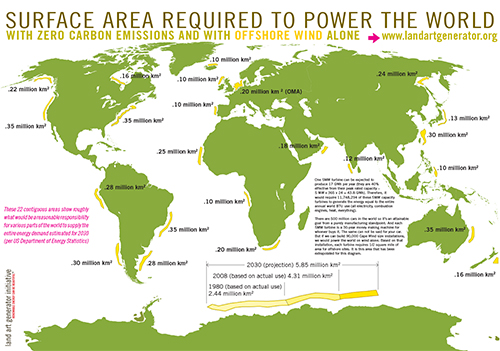
this time around: one is a work of art, the other an infographic.
it is possible to have rows and rows of windmills, occupying surface area .. but at this scale, i think length is slightly more meaningful.
MOOCs: yes's and no's, from the faculty.
i should stop posting article excerpts about this topic. the phenomenon is in full swing, but it's too early to conclude anything about it. for instance, there is no first generation of MOOC college "graduates" yet, so we don't know how stable the framework is.
it's also not clear to me if the objectives for MOOCs have been fully made clear and compatible to the public. as for the faculty, however ..
"John Owens was drawn to MOOCs because of their reach. He also did not want to be left behind... It does not take a programming expert to decrypt the writing on the wall: No matter where you teach, online education is coming. "I would rather understand this at the front end," said Mr. Owens, "than be forced into it on the back end."
...
As far as awarding formal credit is concerned, most professors do not think their MOOCs are ready for prime time. Asked if students who succeed in their MOOCs deserve to get course credit from their home institutions, 72 percent said no."
~ from "The Professors Who Make the MOOCs" @the_chronicle
beyond public key encryption.
well, if number theory can encrypt data, then i suppose that abstract algebra can improve things further ..
"The numbers in the file remain encrypted at all times, so Bob cannot learn anything about them. Nevertheless, he can run computer programs on the encrypted data, performing operations such as summation. The output of the programs is also encrypted; Bob can’t read it. But when he gives the results back to Alice, she can extract the answer with her decryption key.
The technique that makes this magic trick possible is called fully homomorphic encryption, or FHE. It’s not exactly a new idea, but for many years it was viewed as a fantasy that would never come true."
~ from "Alice and Bob in Cipherspace" @americanscientist
beyond the tenure track.
first, the excerpt ..
"Enter “Beyond Academia,” the first career conference at the University of California, Berkeley, organized solely by Ph.D. students and postdoctoral fellows, an unlikely group for a non-academic job fair. The sold-out event — to be held in Berkeley this Friday, March 22 — is a quiet revolution if one considers the investment of time and money that goes into grooming a grad student for a tenure-track position.and now, a few comments: academia is self-selective. the faculty that one meets during one's ph.d. are in fact the survivors, and those in their cohort who "didn't make it" are unrepresented and probably un-measured.
“There are Ph.D. students who feel they can’t come out and say they want to leave academia, they’re too afraid,” said Els van der Helm, a fifth-year Ph.D. student in psychology and lead organizer of the conference. “This will give them a chance to explore other options. We have to start a conversation about this because academia is not for everyone.”
~ from "Ph.D. students rethink the tenure track, scope out non-academic jobs" @newscenter.berkeley
so despite the motives for this kind of conference, it kind of makes sense. it's not like one's ph.d. supervisor would have a lot of information about non-academic jobs, because (s)he's spent an entire career gearing for the opposite.
hacking creativity.
part of me hopes that the creative process will always remain a mystery, with a level of randomness and experience that makes it fundamentally human. on the other hand, if someone could give me a recipe for being able to prove the theorems i want .. then yes: i'm sold! (-:
at any rate, the human brain is a rather interesting entity, and these excerpts are about its creative impulses.
"Time is the raw material of creation. Wipe away the magic and myth of creating and all that remains is work: the work of becoming expert through study and practice, the work of finding solutions to problems and problems with those solutions, the work of trial and error, the work of thinking and perfecting, the work of creating. Creating consumes. It is all day, every day. It knows neither weekends nor vacations. It is not when we feel like it. It is habit, compulsion, obsession, vocation. The common thread that links creators is how they spend their time. No matter what you read, no matter what they claim, nearly all creators spend nearly all their time on the work of creation. There are few overnight successes and many up-all-night successes."
~ from "Creative People Say No" @medium
once again, a few more thousand words.
this time around: one is a work of art, the other an infographic.

it is possible to have rows and rows of windmills, occupying surface area .. but at this scale, i think length is slightly more meaningful.
Tuesday, March 05, 2013
i have glimpsed the future. (it looks pretty cool.)
// initially posted: 14:46EEST
so today i gave an expository talk [1] ..
.. neither on a chalkboard nor a whiteboard, nor with beamer .. well, maybe 2 slides ..
.. but with a SMΛRT Board!

i must say that the interface is pretty cool. at some point i could copy-&-paste an entire equation (though, at the time, i was trying to take just one side of the equation).
as a downside, though, my handwriting is slightly worse than on white (marker) boards. it resembles that of a 6-year old:

oh well: at least this is a sign that the future i want is slowly coming to pass .. (-:
(on a related note, i didn't import a PDF and try to write on it. i wonder how flexible that interface would be ..)
it was really cool that i never really had to "erase" anything other than if i wrote the wrong symbol. there was always the option of appending another "page" to the end of the SMΛRTboard document, and so i had the benefit of scrolling back to something i had written before.
[1] lab scientists would call this a "journal club" talk, i think.
.. neither on a chalkboard nor a whiteboard, nor with beamer .. well, maybe 2 slides ..
.. but with a SMΛRT Board!
i must say that the interface is pretty cool. at some point i could copy-&-paste an entire equation (though, at the time, i was trying to take just one side of the equation).
as a downside, though, my handwriting is slightly worse than on white (marker) boards. it resembles that of a 6-year old:

oh well: at least this is a sign that the future i want is slowly coming to pass .. (-:
(on a related note, i didn't import a PDF and try to write on it. i wonder how flexible that interface would be ..)
// added: 15:22EEST
ok, one last comment:it was really cool that i never really had to "erase" anything other than if i wrote the wrong symbol. there was always the option of appending another "page" to the end of the SMΛRTboard document, and so i had the benefit of scrolling back to something i had written before.
[1] lab scientists would call this a "journal club" talk, i think.
Monday, March 04, 2013
MoAR: cool, hopefully cool, weird-but-cool, uncool, and weird.
this past week was .. busy, i suppose. more than that, it just seemed full of distractions when all i wanted to do was rewrite some manuscripts.
anyway .. the roundup:
i think it's generally accepted that there are more than five human senses, but imagine having even more .. and new ones, at that:
admittedly, after reading this i pondered how possible it could be to experience four dimensional space .. or at least some representation of a space with four independent parameters, where geometry can be converted to something observable.
these days i don't know mathematics journals so well, mostly because i usually find out new and interesting results from arXiv preprint server first. (this can lead to trouble sometimes, because often i have no idea where to submit an article, when it's ready.)
despite my own habits, i think this is a good step forward for maths and science.
i don't think that it will get to the point where the company will refuse to publish the article, especially if it's been accepted for publication under peer review. on the other hand, never underestimate the power of greed.
i don't know about you, but i see a familiar shape here.
what i'd like to know is what the average "split" is, in north america.
i take it that the scifi writer, s. lem, wasn't aware of "pair of pants" decompositions from hyperbolic geometry. (-:
anyway .. the roundup:
1. sensing the invisible.
i think it's generally accepted that there are more than five human senses, but imagine having even more .. and new ones, at that:
"In a study published last week, for instance, Nicolelis’s group at Duke used brain implants to allow mice to sense infrared light, something mammals can’t normally perceive. They did it by wiring a head-mounted infrared sensor to electrodes implanted into a part of the brain called the somatosensory cortex... "virtual space," you say? how virtual?
Similarly, Nicolelis thinks in the future humans with brain implants might be able to sense x-rays, operate distant machines, or navigate in virtual space with their thoughts, since the brain will accommodate foreign objects including computers as part of itself."
~ from "The Brain Is Not Computable" @techreview
admittedly, after reading this i pondered how possible it could be to experience four dimensional space .. or at least some representation of a space with four independent parameters, where geometry can be converted to something observable.
2. on open access (or: sweet!)
these days i don't know mathematics journals so well, mostly because i usually find out new and interesting results from arXiv preprint server first. (this can lead to trouble sometimes, because often i have no idea where to submit an article, when it's ready.)
despite my own habits, i think this is a good step forward for maths and science.
"The White House has moved to make the results of federally funded research available to the public for free within a year, bowing to public pressure for unfettered access to scholarly articles and other materials produced at taxpayers' expense.however, publishing companies are probably not eager to see their profits drop .. so i predict that they will start charging authors in order to meet the new mandate.
"Americans should have easy access to the results of research they help support," John Holdren, the director of the White House Office of Science and Technology Policy, wrote on the White House website."
~ from "White House directs open access for government research" @reuters
i don't think that it will get to the point where the company will refuse to publish the article, especially if it's been accepted for publication under peer review. on the other hand, never underestimate the power of greed.
3. familiar yet unexpected
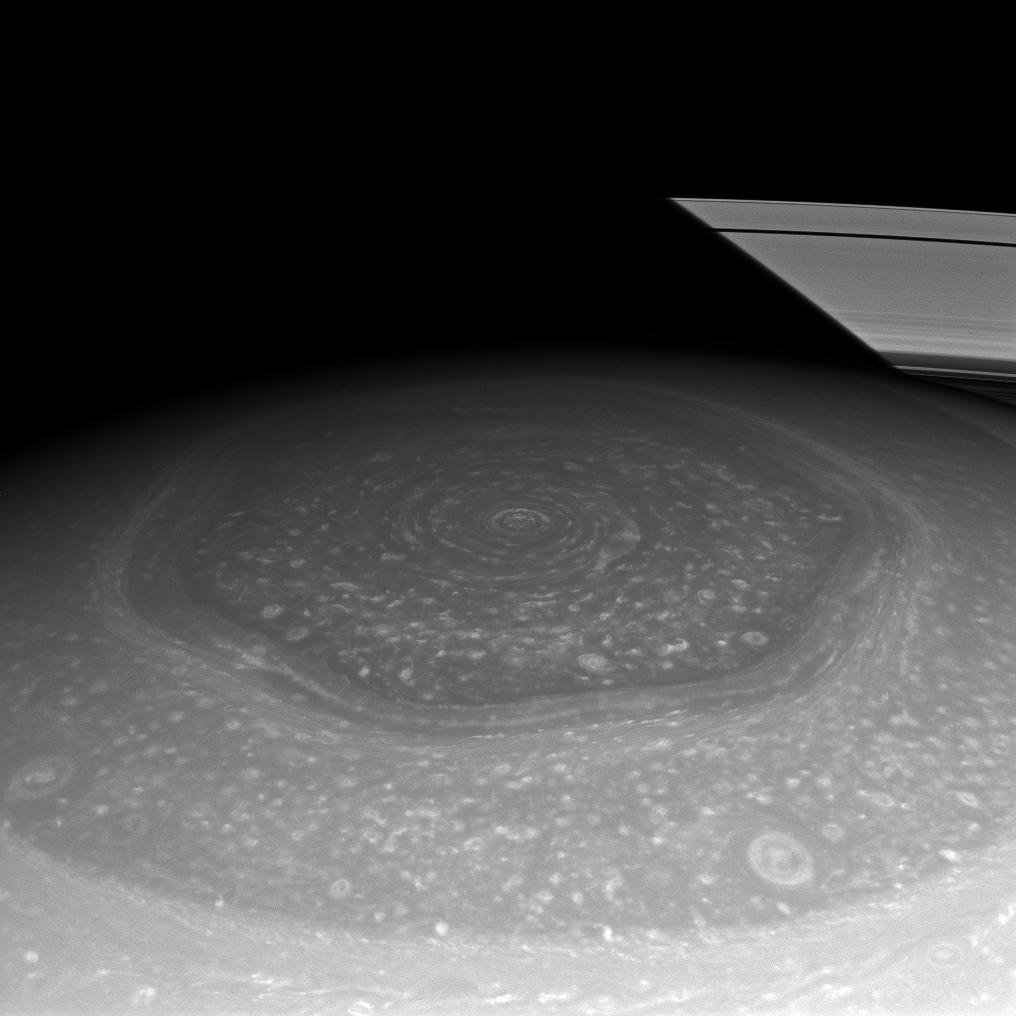
i don't know about you, but i see a familiar shape here.
This and similar images show the stability of the hexagon even 20+ years after Voyager. Movies of Saturn's North Pole show the cloud structure maintaining its hexagonal structure while rotating. Unlike individual clouds appearing like a hexagon on Earth, the Saturn cloud pattern appears to have six well defined sides of nearly equal length. Four Earths could fit inside the hexagon.
~ from "Saturn's Hexagon and Rings " @nasa.gov
4. different assumptions, flawed data.
what i'd like to know is what the average "split" is, in north america.
" The test that Henrich introduced to the Machiguenga was called the ultimatum game. The rules are simple: in each game there are two players who remain anonymous to each other. The first player is given an amount of money, say $100, and told that he has to offer some of the cash, in an amount of his choosing, to the other subject. The second player can accept or refuse the split. But there’s a hitch: players know that if the recipient refuses the offer, both leave empty-handed. North Americans, who are the most common subjects for such experiments, usually offer a 50-50 split when on the giving end. When on the receiving end, they show an eagerness to punish the other player for uneven splits at their own expense.there's more.
..
When he began to run the game it became immediately clear that Machiguengan behavior was dramatically different from that of the average North American. To begin with, the offers from the first player were much lower. In addition, when on the receiving end of the game, the Machiguenga rarely refused even the lowest possible amount. “It just seemed ridiculous to the Machiguenga that you would reject an offer of free money,” says Henrich. “They just didn’t understand why anyone would sacrifice money to punish someone who had the good luck of getting to play the other role in the game.”"
~ from "We Aren't the World" @psmag
"But the most chilling potential problem is that the data we use to guide ourselves can be incomplete or overly reductionist. Many crimes go unreported, which could fool predictive policing software into thinking a neighborhood is safe. Cops on the beat, however, might be able to tell when things don’t seem quite right there and keep an eye out. Morozov fears a future in which such “intuitive knowledge” about how to deploy resources is overruled by algorithms that can work only with hard data and can’t, of course, account for the data they don’t have."
~ from "The Problem with Our Data Obsession" @mit_techreview
5. an interesting analogy..
i take it that the scifi writer, s. lem, wasn't aware of "pair of pants" decompositions from hyperbolic geometry. (-:
"Let us imagine a mad tailor who makes all sort of clothes. He does not know anything about people, birds, or plants. He is not interested in the world; he does not examine it. He makes clothes but does not know for whom. He does not think about it. The tailor is only concerned about one thing: he wants to be consistent. […] He takes the finished clothes to a massive warehouse. If we could enter it, we would discover that some of the clothes fit an octopus, others fit trees, butterflies, or people. We would find clothes for a centaur and for a unicorn as well as for creatures they have not even been imagined yet. The great majority of his clothes would not find any applications.
Mathematics works in the same way. It builds structures but it is not clear of what. These are perfect models (i.e., perfectly accurate), but a mathematician does not know what they are models of. He is not interested. He does what he does because such an action has turned out to be possible."
~ from S. Lem's "Summan Technologiae" @facebook
Monday, February 25, 2013
MoAR: mostly about reality and about education, this week.
I. in which $x^2 - x - 1 = 0$ is really intuitive, actually.
when i think about this experiment, it completely defies my intuition about human vision.
i would have thought that of all the shapes that appear in nature, something symmetric like a square or a circle would be the most readily recognised and processed ..
" Then, in 2009, a Duke University professor demonstrated that our eyes can scan an image fastest when its shape is a golden rectangle. For instance, it’s the ideal layout of a paragraph of text, the one most conducive to reading and retention. This simple shape speeds up our ability to perceive the world, and without realizing it, we employ it wherever we can."i also learned that there is such a thing as optimal fractaΙ densιty too.
~ from "Why We Love Beautiful Things" @nyt
" Certain patterns also have universal appeal. Natural fractals — irregular, self-similar geometry — occur virtually everywhere in nature: in coastlines and riverways, in snowflakes and leaf veins, even in our own lungs. In recent years, physicists have found that people invariably prefer a certain mathematical density of fractals — not too thick, not too sparse. The theory is that this particular pattern echoes the shapes of trees, specifically the acacia, on the African savanna, the place stored in our genetic memory from the cradle of the human race. To paraphrase one biologist, beauty is in the genes of the beholder — home is where the genome is.
LIFE magazine named Jackson Pollock “the greatest living painter in the United States” in 1949, when he was creating canvases now known to conform to the optimal fractal density (about 1.3 on a scale of 1 to 2 from void to solid). Could Pollock’s late paintings result from his lifelong effort to excavate an image buried in all of our brains?"
~ from "Why We Love Beautiful Things" @nyt
II. the universe may or may not be finite, but the internet certainly is.
interesting: as a graph (and hence a metrιc space) apparently the internet has a rather small diameter.
"No one knows for sure how many individual pages are on the web, but right now, it’s estimated that there are more than 14 billion. Recently, though, Hungarian physicist Albert-László Barabási discovered something surprising about this massive number: Like actors in Hollywood connected by Kevin Bacon, from every single one of these pages you can navigate to any other in 19 clicks or less.i can only imagine, then, how much branching there is ..
Interestingly, this means that no matter how large the web grows, the same interconnectedness will rule. Barabási analyzed the network looking at a variety of levels—examining anywhere from a tiny slice to the full 1 trillion documents—and found that regardless of scale, the same 19-click-or-less rule applied."
~ from "Any Two Pages on the Web Are Connected By 19 Clicks or Less" @smithsonian
III. MOOCs: which way now, the tide?
well, this guy said what i said better .. and in particular, more quantitatively:
"First, student attrition rates — around 90 percent for some huge online courses — appear to be a problem even in small-scale online courses when compared with traditional face-to-face classes. Second, courses delivered solely online may be fine for highly skilled, highly motivated people, but they are inappropriate for struggling students who make up a significant portion of college enrollment and who need close contact with instructors to succeed."
~ from "The Trouble with Online Education" @nyt
"Every January, millions of people join gyms that they won’t go to more than a few times before other things get in the way. The problem? “Getting fit” or “losing weight” aren’t things that happen immediately. Those gym visits require a lot of effort–we lose at least an hour of our day, we wake up with new aches and pains, and we face the embarrassment of public struggle–all for what usually amounts to very small visible results. So, despite our logic telling us that being fit is a long-term win, we quit not long after we start.The same is true for learning tech (or anything else) online. Logic tells us that expanding our knowledge via that machine learning course is a long-term win, but the lack of immediate results against the weight of “all the other stuff that’s going on” oftentimes causes us to drop out before we really get started."
~ from "Fixing Online Technology Education" @kufikia
IV. as the ancients have said, "know thyself."
this excerpt gives me a small bit of hope, that our students know themselves well enough to make good decisions about their academic careers.
" They found students believe ”that the paper textbook remains the superior technology for studying and achieving academic success.” Print’s primary advantage is that it presents “fewer distractions,” the students said: “The paper textbook helps them to avoid the distractions of being on the computer or the Internet, the temptations associated with checking e-mail, Facebook, or surfing the Web for unrelated information.”"
~ from "Students to e-textbooks: no thanks" @roughtype
V: .. & now a few more thousand words ..
1. i am very glad that some surfaces are not, say, area-minimising. (-:
"This extra surface comes to use courtesy of our especially wrinkled brains. But there’s another intriguing thing about those wrinkles: they are not spread uniformly across our heads. The front of the neocortex is more wrinkly than the back. This is intriguing, because the front of the cortex handles much of the most abstract sorts of thinking. Our brains pack extra real estate there with additional folds. And if you look at mammals in general, they tend to have more wrinkles at the front than the back."2. then there is what we can see, what we can't, but what bees can:
~ from "On the Possible Shapes of the Brain" @nationalgeographic

" By placing electrodes in the stems of petunias, the researchers showed that when a bee lands, the flower’s potential changes and remains so for several minutes. Could this be a way by which flowers tell bees another bee has recently been visiting? To their surprise, the researchers discovered that bumblebees can detect and distinguish between different floral electric fields."3. lastly, out of seven possible charts from the following link, here is one.


~ from "Floral signs go electric" @uni.bristol
~ from "The Ph.D Bust: America's Awful Market for Young Scientists—in 7 Charts" @the_atlantic

Monday, February 18, 2013
MoAR: not many this week, but there's (i) design, (ii) psychology, and (iii) biology.
by accident i saved over an earlier draft [1] of this week's roundup ..
.. which was rather annoying, as i lost a rather long rant in rebuttal to this article about classroom technology.
so here is what i rounded up today, on short notice:
well, apparently i've not been paying attention to the design world!
similarly, i don't think "flat" has much to do with geometry. as the same author describes, though ..
[shrugs]
that seems pretty 'flat' to me. i would prefer the term: "locally flat" ..
.. but anyway, if you were wondering: apparently the image on the left is flat (in the design sense) and the other is not.

first of all: yes, this is another article about online education. while browsing it, two thoughts came to mind.
ii.1. maybe it's the mathematician in me, but i rarely mind it whenever someone points out the "obvious" to me .. provided that they do so, with style:
ii.2. it's worth noting that browsing for content is something quite different from enrolling in a course, though. the next excerpt is interesting in how psychology comes into play, regarding enrollment.
i still believe that when students are participating in their online courses, then they are paying much better attention than they would in, say, a randomly selected physical-classroom lecture. that doesn't say anything, however, about how often they will exercise their attention skills.
in particular, if they treat the content like any other media -- such as music, films, or television shows -- then their experience will likely consist of sporadic but concentrated bursts of activity instead of a regular, orderly routine. the problem with digital formats and experiences is that they are largely driven by (near to) immediate gratification. it's not clear to me whether the average student is sufficiently prescient and self-aware to account for this, and subsequently exercise such a deliberate practice.
it's not clear to me if this is an effective way of learning anything hard .. especially if, like mathematics, the topic is sequential. i imagine a student following the first few lectures, not visiting the website in a while, and then trying to cram all the video lectures into one big viewing (due to a deadline of some kind). like cramming for exam, this is probably not going to work.
the video format is great when you want to follow an entire procedure or narrative. on the other hand, it is rigid in the sense that it is necessarily chronological. as a result, to guarantee that you get everything you want from it, you either have to (a) sit through all of it or (b) be very good at pause/rewind/fastforward and sifting the information you need.
i'm starting to wonder: if MOOCs are to eventually fail, then would it be due to students being all too human, carrying on the same bad habits that already lead to disaster in physical classrooms?
interesting. computational biology might suddenly get a lot more real.
[1] as you may have guessed, usually i bookmark the articles links over the course of the week .. and when bored, start adding my personal rants to self-servingly-selected excerpts.
.. which was rather annoying, as i lost a rather long rant in rebuttal to this article about classroom technology.
so here is what i rounded up today, on short notice:
i. mathematically sounding jargon .. from design.
well, apparently i've not been paying attention to the design world!
"If you're paying attention to what's going on in the design world, you've probably noticed the ongoing debate around skeuomorphism vs flat design."apparently, skeuomorphism isn't a special kind of homeomorphism .. not that i can tell, anyway. (it's probably not even a coarse isometry .. or what others call a 'rough' or 'quasi-isometry.')
~ from "flat pixels" @sachagreif
similarly, i don't think "flat" has much to do with geometry. as the same author describes, though ..
"Flat Style embraces visual minimalism, eschewing textures and lighting effects for simple shapes and flat colors.".. and apparently, "flat color" is a technical term in art, too. so if one thinks of colors as as a spectrum (i.e. a nonempty compact interval of real numbers) and an image as a function from a rectangle in the coordinate plane to this interval, then would flat-coloured image would be a piecewise constant function?
[shrugs]
that seems pretty 'flat' to me. i would prefer the term: "locally flat" ..
.. but anyway, if you were wondering: apparently the image on the left is flat (in the design sense) and the other is not.
ii. revising our assumptions (on MOOCs)
first of all: yes, this is another article about online education. while browsing it, two thoughts came to mind.
ii.1. maybe it's the mathematician in me, but i rarely mind it whenever someone points out the "obvious" to me .. provided that they do so, with style:
"What I’m saying is we have to start from the position that the tidal wave is already here. Indignation, however righteous, is beside the point. The kids who are cutting their teeth on Khan Academy videos for help with their chemistry and calculus homework will grow up correctly assuming that there will always be low-cost or free educational opportunities available to them online in virtually any field of inquiry. They will naturally migrate to the best stuff and be less and less willing to pay for crap. This will cause a lot of trauma for the educational establishment, but that’s not the problem of the next generation that wants to learn."i don't know if this is obviously true. for now, however, the availability of search, in some form, seems to be a reasonably good assumption for the future.
~ from "the Internet will not ruin college" @salon
as for my own habits, i generally prefer text to video,
so often i browse through wikipedia, pick the wikis i want,
then follow the listed references on them.
so often i browse through wikipedia, pick the wikis i want,
then follow the listed references on them.
ii.2. it's worth noting that browsing for content is something quite different from enrolling in a course, though. the next excerpt is interesting in how psychology comes into play, regarding enrollment.
"It strikes me as a profound realization of the fundamental goal of the university — any university — that a course taught by an icon at one of the most elite institutions in the world would be accessible to me for just the cost of a few clicks ... But it seemed like too big a commitment to make while on deadline, so I ended up browsing..."so i might have to change my mind in what i wrote in a previous roundup:
i still believe that when students are participating in their online courses, then they are paying much better attention than they would in, say, a randomly selected physical-classroom lecture. that doesn't say anything, however, about how often they will exercise their attention skills.
in particular, if they treat the content like any other media -- such as music, films, or television shows -- then their experience will likely consist of sporadic but concentrated bursts of activity instead of a regular, orderly routine. the problem with digital formats and experiences is that they are largely driven by (near to) immediate gratification. it's not clear to me whether the average student is sufficiently prescient and self-aware to account for this, and subsequently exercise such a deliberate practice.
a course website is still a website. it's probably going to be opened in a web-browser, along with other browsing tabs for email, social media, etc .. and that's only the web browser, a single program that is running on the computer.
maybe the average online student will be a distracted, multitasking one.
so far the "success stories" have a self-selecting population: if you're not enrolled in a university and want to take an online course, then it's your own commitment. what happens when university-enrolled students are drafted into the same environment? can we really expect such a significant behavioral change?
it's not clear to me if this is an effective way of learning anything hard .. especially if, like mathematics, the topic is sequential. i imagine a student following the first few lectures, not visiting the website in a while, and then trying to cram all the video lectures into one big viewing (due to a deadline of some kind). like cramming for exam, this is probably not going to work.
the video format is great when you want to follow an entire procedure or narrative. on the other hand, it is rigid in the sense that it is necessarily chronological. as a result, to guarantee that you get everything you want from it, you either have to (a) sit through all of it or (b) be very good at pause/rewind/fastforward and sifting the information you need.
in contrast, you can easily skim through a wiki; text is spatially ordered, you see .. not chronologically.
i'm starting to wonder: if MOOCs are to eventually fail, then would it be due to students being all too human, carrying on the same bad habits that already lead to disaster in physical classrooms?
iii. organisms are turning into computers, whereas computers are turning into .. doctors?
interesting. computational biology might suddenly get a lot more real.
"Synthetic biology seeks to bring concepts from electronic engineering to cell biology, treating gene functions as components in a circuit. To that end, researchers at the Massachusetts Institute of Technology (MIT) in Cambridge have devised a set of simple genetic modules that respond to inputs much like the Boolean logic gates used in computers."on a related note,
~ from "How to turn living cells into computers" @nature
"By using a new framework that employs sequential decision-making, the previous single-decision research can be expanded into models that simulate numerous alternative treatment paths out into the future; maintain beliefs about patient health status over time even when measurements are unavailable or uncertain; and continually plan/re-plan as new information becomes available. In other words, it can "think like a doctor." ..."so by the law of syllogism, surely we can engineer our own cells to become their own doctors? (-;
~ from "Can computers save health care?.." @iu.newsroom
[1] as you may have guessed, usually i bookmark the articles links over the course of the week .. and when bored, start adding my personal rants to self-servingly-selected excerpts.
Thursday, January 31, 2013

Monday, January 28, 2013
MoAR: a few applied gems, and a teaser.
last week was busy, for a number of reasons, all of which involved humans:
that said, this week's roundup is pretty bare. there are only 3 articles instead of a maximum of 5, and i've made no comments about them. then again, the summaries seem to speak for themselves ..
"Life is short for small creatures, longer in big ones. So algae die sooner than oak trees; elephants live longer than mayflies, but you know that. Here's the surprise: There is a mathematical formula which says if you tell me how big something is, I can tell you — with some variation, but not a lot — how long it will live. This doesn't apply to individuals, only to groups, to species. The formula is a simple quarter-power exercise: You take the mass of a plant or an animal, and its metabolic rate is equal to its mass taken to the three-fourths power."
"You are watching an optimisation algorithm come up with the best design completely automatically.The outcome is greatest stiffness shape possible for a given amount of material. And amazingly it’s a nuanced truss that isn’t far removed from the look of most motorway bridges. That’s pretty reassuring, actually.

The engineering-y name for this process is ‘topology optimisation’ - essentially making the best use of shape for structures. It’s been the aim of structural engineers since their existence and evolutionary algorithms are a modern development to help this."
"Markov was abrasive, confrontational, and iconoclastic, “Andrew the Furious,” one contemporary called him. "
meeting up with friends,so i felt very managerial for most of the week, and as a result, got very little done. every time i was intent on finishing up a $\LaTeX$ writeup, there seemed to be another meeting or appointment to take.
colleagues (new and old) coming to visit,
even an ex-girlfriend showing up to town.
that said, this week's roundup is pretty bare. there are only 3 articles instead of a maximum of 5, and i've made no comments about them. then again, the summaries seem to speak for themselves ..
a hidden biological invariant?
"Life is short for small creatures, longer in big ones. So algae die sooner than oak trees; elephants live longer than mayflies, but you know that. Here's the surprise: There is a mathematical formula which says if you tell me how big something is, I can tell you — with some variation, but not a lot — how long it will live. This doesn't apply to individuals, only to groups, to species. The formula is a simple quarter-power exercise: You take the mass of a plant or an animal, and its metabolic rate is equal to its mass taken to the three-fourths power."
algorithm as flow.
"You are watching an optimisation algorithm come up with the best design completely automatically.The outcome is greatest stiffness shape possible for a given amount of material. And amazingly it’s a nuanced truss that isn’t far removed from the look of most motorway bridges. That’s pretty reassuring, actually.
The engineering-y name for this process is ‘topology optimisation’ - essentially making the best use of shape for structures. It’s been the aim of structural engineers since their existence and evolutionary algorithms are a modern development to help this."
~ from "algorithms that design structures better than engineers" @jordanburgess
a teaser, for a forthcoming lecture series.
"Markov was abrasive, confrontational, and iconoclastic, “Andrew the Furious,” one contemporary called him. "
~ from "an idea that changed the world" @news/harvard
Monday, November 05, 2012
mildly interesting: factoring numbers, self-similarly.
a friend of mine sent me the link to these animated factorisation diagrams, which are captured below as stills.
 |
| primes are displayed as circles .. |
 
|
| whereas for each factor, like the 5's in 250 or the 2's and 3's in 216, another level of self-similarity is added. |
  |
| admittedly i kept waitingfor another power of 2 or 3, just to see more iterations of four-corner sets and sierpinski-type triangles .. (-: |
Wednesday, October 31, 2012
mildly interesting: i don't see a singularity .. but still cool.
over at abstractstrategygames they've posted about a so-called singularly chess, where the pieces and rules are the same as usual (western) chess but the boards are non-linearly tiled ..
.. almost like a polar coordinate system;
as a result, pieces move in unconventional ways:

for more examples, visit the abstractstrategygames website (here).
.. almost like a polar coordinate system;
as a result, pieces move in unconventional ways:
for more examples, visit the abstractstrategygames website (here).
Friday, October 19, 2012
mildly interesting: time as a spatial dimension (photographically)
these are spacetime photos, as found off an article @slate:

in the words of the author:

.
in the words of the author:
"The abstract-seeming images here are not the result of some wacky Photoshopping. Jay Mark Johnson’s photos are actually incredibly precise. The reason they look like this is because he uses a slit camera that emphasizes time over space.it therefore makes sense that a periodic motion, like that of ocean waves, would appear the same as a typical photograph:
..
This unique look is possible because the fixed-position slit camera registers only a vertical sliver of a scene. Whatever passes that slit by gets registered in a narrow line. Over a period of time, which Johnson can control, it registers line after line. The final result is a bunch of these lines all pushed together. (In this sense, you could say each photograph is actually a composite of hundreds of very skinny images.)"
.
Subscribe to:
Posts (Atom)