Showing posts with label MOOCs. Show all posts

Wednesday, July 31, 2013

a particular MOOC that's been coming up in my feeds.

i'm curious to see how this particular course on mathematical philosophy unfolds. at first glance it reads like a discrete mathematics course that i took for a computer science major* but with more "relevant" and "edgy" material ..
such as the mοnty hall problem and ) arrow's voting paradox (also called an "impossibility theorem").**

another interesting aspect is the topics in game theory, such as the von Neumann-Morgenstern axioms.
looking through the syllabus, i would rather call this a "mathematics literacy" course. the title of 'mathematical philosophy' suggests it as part of philosophy of mathematics, from whose recurrent themes strikes me as a wholly different thing!


* not that i ever completed the major. it was my final semester for my undergraduate degree, i had a 3-credit course left called "operating systems," but by all accounts i would have had to spend 20 hours per week, just coding. i decided to take a topics in ΡDEs course which, in the long run, was a wiser and more useful choice. (-:

** it's funny how we become aware of certain facts. i actually learned of the latter result from an acquaintance, while couchsurfing .. about 9 years ago? similarly, the vNM axioms came up when one of my students from a proofs class wanted to write his term paper on economics and game theory.

Monday, July 29, 2013

ARR! point & counterpoint.

so i've been reading about MOOCS again. here are a few excerpts i found:


"What you can do over the Internet this way is deliver information, but that's not education. Education, as any real teacher will tell you, involves more than just transmitting facts. It means teaching students what to do with those facts, as well as the skills they need to go out and learn new information themselves."

(as pointed out in "The MOOC Racket" @slate)

".. are we sure the only way to teach people what to do with facts is face-to-face? This seems like something that could at least conceivably be taught to more than one person at once. I can remember lots of professors teaching me what to do with facts via lectures in extremely large auditoriums, which is not that different than a lecture you watch online."

(a counterpoint via College Professors Are About to Get Really Mad at President Οbama @nymag)


ye gods, this issue is confusing, especially when one accounts for the perspectives of the given pundits. for one thing ..
.. the first point comes from a university professor, who has probably developed an expertise in little-known fields (or at least poorly popularised) over years of study in academia. for him, relevant professional information typically arrives through academic channels and processing the information is a careful, length process of some depth. (think of the peer review process: ouch!)

the second point comes from a editor/journalist who has developed a different expertise in a widely-recognised occupation, probably by way of on the job training and less formal study [1]. relevant professional information probably comes through many diverse channels and rapidly so; the process of response probably requires similar speed (in order to remain relevant).
there are also tacit yet important questions here:

for a young adult, is college necessary for a future successful career?
if so, then what should (s)he learn at university?


honestly, i have no idea. there are too many types of careers out there for a simple answer. the issue gets even murkier when you account for advances in technology, even at the scale of a generation or two.
for example, it seems that there is a lack of available workers in the skilled trades, and the current infrastructure of civilization relies crucially on the fruits of their labor.

on the other hand, what if 3-D printing becomes robust enough, and available through a sufficiently diverse selection of materials, so that plumbing, welding, and soldering no longer require the work of human hands?

this sounds like science fiction, of course. i'll not discuss the likelihoods of certain events occurring .. mostly because i cannot even guess, much less quantify the time-dependent sample space of modern civilisation.

on the other hand, i would like to point out that they are real possibilities: take, for example, the history of the Luddites or how human computers were replaced by digital ones. now that i think about it, i wonder how many more travel agents there are nowadays, with the popularity of flight search engines and all ..? [2]

at any rate, the main problem is that we don't know what "workers of the future" need to know how to do, because many of those future jobs don't exist yet. (explain, for example, the notion of a web developer to someone in the 1970s.) at best we can only make decisions about how to help young adults now, with well-defined criteria ..

.. such as economic ones, i.e. whether they should be obligated to put themselves into tens of thousands of dollars in debt before the age of 30?


[1] this is not to say that the second writer knows any less than the first, nor is he any worse at his job. honestly, you cannot compare such experiences. if the second writer is a success, then i would guess that has to do with a lot of deliberate and systematic effort on his part. he may even have studied many journalists he has admired, read very carefully their work and took notes, which is clearly a kind of study, but not the formal kind you see in universities.

if this is his approach, then i applaud the guy. deliberate practice of this kind, regardless of the circumstance, is often necessary to succeed in many areas in life.


[2] actually, there may in fact be more travel agents than ever before. travel for pleasure has become more and more accessible; on the other hand, there is still a large population out there who cannot (or will not) deal with a computer .. or even afford a computer or high-speed internet. \-:

Monday, June 24, 2013

MoAR #25: inter alia, the human kind of asymmetry.

well, it's been 25 of these roundups. my guess, as before, is that you readers can probably do your own news searches, and with greater effectiveness to fit your own tastes.

that said, i'll still be posting articles i find interesting, but just not in roundup form anymore.


1. not the isomorphism that i expected, but ..

.. apparently some processes are universal, whether organic or digital:
"On the surface, ants and the Internet don't seem to have much in common. But two Stanford researchers have discovered that a species of harvester ants determine how many foragers to send out of the nest in much the same way that Internet protocols discover how much bandwidth is available for the transfer of data."

~ from "Stanford researchers discover the 'anternet'" @stanford.edu

2. the 'flame' kind of war

when i read this excerpt, the first thing which came to mind was:

why is this even a question? we haven't stopped teaching spelling, grammar, and vocabulary to students, just because they now have word processors, right?
The standard algorithms should be avoided because, reformists claim, mastering them is a merely mechanical exercise that threatens individual growth. The idea is that competence with algorithms can be substituted for by the use of calculators, and reformists often call for training students in the use of calculators as early as first or second grade.
..
That the use of standard algorithms isn’t merely mechanical is not by itself a reason to teach them. It is important to teach them because, as we already noted, they are also the most elegant and powerful methods for specific operations. This means that they are our best representations of connections among mathematical concepts.


~ from "The Faulty Logic of the ‘Math Wars’" @nyt
admittedly, though, a lot of times i just opine when i feel like it, and drop things when i don't ..
These professors maintain that college-level work requires ready and effortless competence with the standard algorithms and that the student who needs to ponder fractions — or is dependent on a calculator — is simply not prepared for college math. They express outrage and bafflement that so much American math education policy is set by people with no special knowledge of the discipline.
to be honest, i don't know who really is in charge of mathematics educational policy, but i strongly suspect that most college faculty opt out of any involvement with it. call it a professional opportunity cost: unless you rake in a lot of external funding from it, there's not a lot of incentive to work on educational problems instead of research ones.


3. wait .. what?

there are plenty of shocking items of news in the world lately, like:
This year, a pilot scheme was introduced to enforce the rules.
..
When students at the No.3 high school in Zhongxiang arrived to sit their exams this month, they were dismayed to find that they would be supervised by 54 randomly selected external invigilators.
..
By late afternoon, the invigilators were trapped as students pelted the windows with rocks. Outside, more than 2000 people had gathered, smashing cars and chanting: ''We want fairness. There is no fairness if you do not let us cheat.''
..
The protesters claim cheating is endemic in China and that sitting the exams without help puts their children at a disadvantage.


~ from "Chinese students and families fight for the right to cheat their exams" @smh
the last excerpt warrants interpretation; i think the protest is specific to why their city was chosen for enforcement, instead of other cities. the article goes on to point out that last year, the education department received 99 identical exam papers .. but then again, there's no comparison as to how other cities' stats stack up.

imagine, for example, if other cities had been recorded at 500+ identical copies.

considering the population of certain cities in china, that's no longer a large number of students;
as a result, without additional data i wouldn't rule out political favoritism yet ..

nonetheless, this kind of news is alarming. i've heard that eastern culture favors the group over the individual, and that the socioeconomic inequity in india and china is huge, but .. really?

well, moving towards a more abstract direction ..
The researchers are trying to avoid a situation where we outsmart ourselves, and create a system that can in turn invent its own technologies, which could "steamroll" humanity – not because it’s evil, but simply because we couldn’t foresee the long-term ramifications of how we programmed it.
..
"Think how it might be to compete for resources with the dominant species," Price says. "Take gorillas, for example – the reason they’re becoming extinct isn’t because humans are actively hostile towards them, but because we control the environment in a way that suits us, but is detrimental to their survival.


~ from "The men trying to save us from the machines" @pcpro
considering how well we understand turιng machines yet still face computer crashes regularly, in this day and age, this might not be a bad approach in general. it would be rather .. depressing if all of humanity were swept away, due to a computer glitch!

to a lesser, more realistic extent: the access and operations for my savings and checking accounts are probably automated within some banking computer system. if enough errors pile up, then .. [cringes].


4. to humans, does time lack symmetry?

i would have thought that we humans are good at accounting for symmetry. then again, i'd probably also fall prey to this ..
But when asked to predict what their personalities and tastes would be like in 10 years, people of all ages consistently played down the potential changes ahead.
..
Thus, the typical 20-year-old woman’s predictions for her next decade were not nearly as radical as the typical 30-year-old woman’s recollection of how much she had changed in her 20s. This sort of discrepancy persisted among respondents all the way into their 60s.


~ from "Why You Won’t Be the Person You Expect to Be" @nyt
the main mechanism might be memory, which resides clearly in the past, not the present, and is arguably inherently faulty.

anyway, towards a more familiar setting .. here's a thought that makes sense, but never came to mind when i was teaching:
You would think that since you have been a student and survived you would be able to recognize their misconceptions and guide them to enlightenment. But even if you could remember what it was like to be a student, that moment for you was characterized by a similar hit-and-run-don’t-leave-a-calling-card confusion.

Everybody gets hit by the bus, everybody gets knocked out, everybody survives, but nobody remembers what they got hit by. So you can’t tell them what to watch out for. Teachers can’t understand their students’ confusion even though they once experienced the exact same confusion!


~ from "Teach Like You Don’t Know" @desmondrawls
a good point, but the comparison (i.e. hit-&-run) as well as the phenomenon seems a bit forced. it's not like the act of learning is some version of achilles and the tortoise, right!

maybe the point is the instability of learning. everything is fine for students, as long as they're following diligently and carefully .. but once they trip up, their confusion can be utter confusion. /-:


5. lastly, a bit about online education.

i know that i've ranted on and on about MOOCs a lot, but this is the first article that mentions any behind-the-scenes kind of details:
So, what hasn’t gone as planned? Certainly some things do not translate from a traditional classroom course to a MOOC. Our team realized quickly that we needed to do a better job cross-linking material on the course site. For example, if we mention the syllabus, we must link to it. Some students, we have learned, want a great deal of guidance.
..
We also underestimated the misunderstandings that can arise from idiomatic and discipline-specific language. We began the course by asking students to complete a Personal Benchmark Statement, only to discover that we needed to provide a definition of “benchmark.” A longer glossary of terms became a featured part of our site.


~ from "Inside a MOOC in Progress" @the_chronicle
interesting: in terms of the latter gaffe, in a multivariable calculus class it once took me a week to realise that i'd been calling a $\partial$ a 'del' without actually having told the class of the pronunciation.

(for the record, it was one very brave student who asked in the middle of class; subsequently a collective 'oh' erupted through the lecture hall.)

Monday, May 27, 2013

MoAR: surprises, mostly non-mathematical.

so yes: this week's round-up is late. i blame it all on yesterday's airport transit and today's busy routine in hosting a(nother) visitor.

anyway, most of these aren't really maths related at all ..


wtf?

well, i suppose that it's a form of internet addiction .. but really?
"I don't think it's very healthy" is the confession of Pavel Lepin, a 35-year-old in the Latvian city of Jelgava who has earned certificates in "about 30" MOOCs, some from Coursera, some from Udacity, and some from edX. "My friends and co-workers are already making fun of me for being a Coursera addict."

Mr. Seiter agrees that it as possible to learn as much online as in a traditional course, but that to do so usually requires doing optional readings, which most MOOCers skip.
"

~ from "What Professors Can Learn From 'Hard Core' MOOC Students" @the_chronicle
.. and now, from the physicists:
"Physicists have long known that quantum mechanics allows for a subtle connection between quantum particles called entanglement, in which measuring one particle can instantly set the otherwise uncertain condition, or "state," of another particle—even if it's light years away. Now, experimenters in Israel have shown that they can entangle two photons that don't even exist at the same time. "

~ from "Physicists Create Quantum Link Between Photons That Don't Exist at the Same Time" @sciencenow


measuring intelligence .. somehow?

to some degree, the mechanism seems right .. but does it account for cultural differences?
"This surprisingly simple exercise measures the brain's unconscious ability to filter out visual movement. The study shows that individuals whose brains are better at automatically suppressing background motion perform better on standard measures of intelligence."

~ from "Motion Quotient " @rochester.edu
.. and as for more "depressing" news ..
"This paper proposes to analyse the relationships between depression and high intellectual potential through a multidisciplinary and original approach. Based on their respective experience in psychology and child psychiatry, the authors will focus their analysis on creative potential .. This case study sheds light on the paradoxical role of depression in the overinvestment in intellectual and creative spheres as well as on the impact of traumatic events on high intellectual potential."

~ from "Relationships between Depression and High Intellectual Potential" @hindawi:drt


lastly, a breakthrough.

i would call this an amazing feat of mathematical "engineering" .. which is its own kind of genius. still, i wonder how many mathematicians are slightly disappointed at the lack of new tools that this solution provides.
"As details of his work have emerged, it has become clear that Zhang achieved his result not via a radically new approach to the problem, but by applying existing methods with great perseverance. “The big experts in the field had already tried to make this approach work,” Granville said. “He’s not a known expert, but he succeeded where all the experts had failed.” "

~ from "Unheralded Mathematician Bridges the Prime Gap" @simonsfoundation

Monday, May 13, 2013

MoAR: a variety, this week.

this week's roundup is a little more substantial than in previous weeks .. but not by any extra effort on my part. i looked through the same channels and there was that much more to share, than usual ..

[shrugs]


1. teaching computers like humans.

the human brain apparently has 86 billion neurons, which is a fairly complex computing system. so if it takes us years to learn how to walk, speak, and understand the baηach-alaοglu theorem, then maybe we should allow computers the same educational license.
"With Deep Learning, Ng says, you just give the system a lot of data “so it can discover by itself what some of the concepts in the world are.” Last year, one of his algorithms taught itself to recognize cats after scanning millions of images on the internet. The algorithm didn’t know the word “cat” — Ng had to supply that — but over time, it learned to identify the furry creatures we know as cats, all on its own."

~ from "The Man Behind the Google Brain: Andrew Ng and the Quest for the New AI" @wired


2. contrary evidence, of a few kinds.

in an earlier post i alluded to some statistics about the relative success of asian-american students, as measured by test scores. one may inquire as to what factors lead to these differences .. but apparently, it might not be tiger parenting after all.
"An associate professor of human development and family sciences at the University of Texas, Kim had been following more than 300 Asian-American families for a decade when the book came out. In March, she published her results; they will no doubt surprise Chua and her admirers. Children of parents whom Kim classified as “tiger” had lower academic achievement and attainment—and greater psychological maladjustment—and family alienation, than the kids of parents characterized as “supportive” or "easygoing.”"

~ from "Poor Little Tiger Cub" @slate
that said, this looks like a comparative study within a statistical population of asian-american families. what i'd like to know is whether kids in the u.s. with tiger parents always underperform against their peers with easy-going parents regardless of ethnicity.

in other news, apparently we live on a strange planet:
"We are now beginning to understand that nature seems to overwhelmingly prefer [planetary] systems that have multiple planets with orbits of less than 100 days," says Steve Vogt, astronomer at the University of California, Santa Cruz. "This is quite unlike our own solar system, where there is nothing with an orbit inside that of Mercury. So our solar system is, in some sense, a bit of a freak and not the most typical kind of system that Nature cooks up."

~ from "Our Very Normal Solar System Isn't Normal Anymore" @krulwich-wonders (npr)


3. messages of progress and hope.

for some people (like me) the difficulty with listening to the advice of others is that it seems painfully abstract until it becomes relevant to you .. by which time it's too late to follow the given advice.

for example, even if i were to travel back in time, meet my younger self in his first year of ph.d., somehow convince him that i'm his future self, and give him the best advice that i could, then it still wouldn't be clear to he-that-was-once-me would actually listen to me (that is, the me that i am now).

then again, i could just be a nutcase. so if you're still in your grad school years, then this webpage might be worth a read:
"While you're writing or building, you might feel like your idea sucks and want to stop it early. Unless you're totally convinced after some more thought that your idea is unworkable or totally impractical, keep going. That feeling of discomfort you have might turn out to be your core research problem, and you'll feel better once you finish a draft and identify the unsolved work ahead of you. Even if you're not convinced your idea is great, you should continue. When you present the introduction to your advisor, they might think of something completely different and more exciting. Your crappy first draft will end up being a wonderful first seed for the idea you'll actually start working on!"

~ from "The N=1 guide to grad school" @marcua.net
as for the next article, it's a more serious take on popular science writing than, say, the up goer 5 editor from a while back. who knows? it might even survive the usual lifespan of a single news cycle.
"Your challenge is to write as though explaining your work to an intelligent, capable relative who is totally naïve to your field and its importance. That means more than avoiding jargon; it also means providing some context upfront so readers can appreciate why particular findings might matter."

~ from "Science, Meet The People" @13.7 (npr)


4. trolling, mathematically.

my guess is that the following quote was taken out of context, or that the quoted party was writing an email that wasn't re-read for clarity.
"O’Neil, however, holds Mοlchizuki accountable, saying that his refusal to cooperate places an unfair burden on his colleagues. “You don’t get to say you’ve proved something if you haven’t explained it,” she says. “A proof is a social construct. If the community doesn’t understand it, you haven’t done your job.”"

~ from "The Paradox of the Proof" @projectwordsworth
as far as i've read, Mοlchizuki did not actually submit these articles for publication in a peer-reviewed journal. they were posted on his website, a web-crawler happened to index them into a search engine, and the right search happened to bring the work to the attention of experts.

the practice is non-standard, yes, but non-binding. yes, he claims he has a proof, but he's not forcing others to acknowledge that his proof is correct or even to read it .. so the comment of this being an "unfair burden on his colleagues" sounds ridiculous to me. by that reckoning, i am being an unfair burden because my papers on analysis are not written in an expository way for algebraists to understand immediately.

if the quoted party feels so strongly about having a readable, easily verifiable proof, then (s)he should either work on the same problem to find a better proof .. or quit complaining about papers that (s)he probably wouldn't have read anyway.

that aside, project wordsworth strikes me as an interesting social experiment; they're worth a few mouse clicks.


5. about online education, mercifully put into sound (text?) bites.

in case you're sick of reading about these thing, i'll keep it short.
"Offering MOOCs through edX is hardly free. There are options available to institutions that want to build their own courses on the edX platform at no charge, but for partners who want help developing their courses, edX charges a base rate of $\$$250,000 per course, then $\$$50,000 for each additional time that course is offered; edX also takes a cut of any revenue the course generates."

~ from "Why Some Colleges Are Saying No to MOOC Deals, at Least for Now" @chronicle.

"In spite of our admiration for your ability to lecture in such an engaging way to such a large audience," the letter's authors write, "we believe that having a scholar teach and engage with his or her own students is far superior to having those students watch a video of another scholar engaging his or her students."

~ from "Why Professors at San Jose State Won't Use a Harvard Professor's MOOC" @chronicle

"Online learning startup Coursera on Wednesday announced a partnership with Chegg, a student hub for various educational tools and materials, as well as five publishers to offer students free textbooks during their courses."

~ from "Coursera leaps another online learning hurdle" @tnw

"This sounds good and I'm sure it works with some of the students, but I don't believe it would work on a large scale. One reason is that students discount the future so heavily that I don't believe that students will choose to read a textbook instead of going to work or an extracurricular activity. I think students would choose to enjoy the immediate benefits when the costs come later. "

~ from "Sir Ken Robinson on Education" @mikeroe (via a.isakov)

Sunday, April 28, 2013

MoAR: bad news, questionable news, and ..

it's been a good week:

i'm eating well,
i'm more tanned than i've been in a while,
i meet good friends every day ..

.. and i think a collaborator and i have hammered out the basics for a short new paper .. or rather, a note. it will be about fractals; maybe i'll write about it sometime.

then again, experience tells me that nothing i do is ever short.
[sighs]

that said, this idyll bliss won't last. tomorrow begins a week-long conference and after that i'll be gone again. when i was younger, i'd despair of these endings. growing older now, i start to wonder if the good times are necessarily short with premature ends.

this might explain, then, why i seemed to stumble onto more bad news than good, this week ..


first, the bad news ..

the second paragraph below makes me cringe. cheating has some terrible (and unexpected) consequences.
" Now, looking around during rush hour, as people streamed on and off the platforms, Stapel could not find a location that matched the conditions described in his experiment. “No, Diederik, this is ridiculous,” he told himself at last. “You really need to give it up.”
..
The scrutiny was meant not only to clean up the scientific record but also to establish whether any of Stapel’s co-authors, including more than 20 Ph.D. students he supervised, shared any of the blame. It was already evident that many of the doctoral dissertations he oversaw were based on his fabricated data.
..
".. Science is of course about discovery, about digging to discover the truth. But it is also communication, persuasion, marketing. I am a salesman. I am on the road. People are on the road with their talk. With the same talk. It’s like a circus."


~ from "The Mind of a Con Man" @nyt

i remember being told by my counselor in high school that one should join various clubs, sports teams, and organisations (including charity work) because it looks good in college applications.

i don't know if the following excerpt is true or not. without firsthand accounts of university deans and other higher-ups from that era, it's hard to justify the suggested causality of events. (there's also the problem of presentism, of course.)
" "Holistic admissions criteria emerged at Ivy League schools in the early 20th century and were almost immediately twisted for virulently anti-semitic purposes. Until the 1920s, students took an admissions test and those that did well on the test were admitted to the colleges “almost entirely on the basis of academic criteria.” This resulted in lots of Jewish men on the campus of Harvard, Princeton, and Yale.

It’s around this time that Ivy League schools switched from a strictly quantitative system of test scores to a more subjective, holistic approach. The holistic approach was used to squelch diversity and the number of Jews in American universities then plummeted."
"

~ from "Do Elite Colleges Discriminate Against Asians?" @priceonomics


.. next, some questionable news ..

admittedly, i've thought about the same ethical dilemma before. fortunately for cafe owners, i seem unable to concentrate at a cafe longer than 2 hours, which means more turnover for them.
"I’m sure there are people who spend time like me and spend money more generously. Buying peppermint mochas or pumpkin spice lattes plus a pastry sounds delicious and seems like it buys you as much time as you'd like. Is the time spent at the coffee shop balanced out by what you've purchased at the coffee shop?"

~ from "The ethical coffee shop freelancer" @medium

strange things happen when we digitise them and set them in the grand scale of the internet. despite connecting us to more people, social media may have made us all lonelier. it would be equally strange if the same thing would happen betwen teachers and students ..
"It creates a strange paradox: these professors are simultaneously the most and least accessible teachers in history. And it’s not the only tension inherent in MOOCs."

~ from "Two Cheers for Web U!" @nyt

the next article isn't so much about questionable behavior as it is about peculiar choices. (i see the reasons behind the instructor's choices, but i wouldn't do it myself .. partly because i don't see how pure maths could fit the same model.)
"A week before the test, I told my class that the Game Theory exam would be insanely hard—far harder than any that had established my rep as a hard prof. But as recompense, for this one time only, students could cheat. They could bring and use anything or anyone they liked, including animal behavior experts. (Richard Dawkins in town? Bring him!) They could surf the Web. They could talk to each other or call friends who’d taken the course before. They could offer me bribes. (I wouldn’t take them, but neither would I report it to the dean.) Only violations of state or federal criminal law such as kidnapping my dog, blackmail, or threats of violence were out of bounds.

Gasps filled the room. The students sputtered. They fretted. This must be a joke. I couldn’t possibly mean it. What, they asked, is the catch?

“None,” I replied. “You are UCLA students. The brightest of the bright. Let’s see what you can accomplish when you have no restrictions and the only thing that matters is getting the best answer possible.”"
"

~ from " Why I Let My Students Cheat On Their Game Theory Exam " @popsci

lastly: imagine that, instead of time or distance, we could parametrise curves based on income?

~ from "INEQUALITY AND NEW YORK’S SUBWAY" @newyorker


.. and now, the good news.

actually, none of the excerpts below are inherently "good." they're just bits of news that don't depress me or cause me malaise.

for example, this is an excerpt from a pretty good expositional article:
"Yet for the most part, complex numbers are treated as an inconvenience. Because they are inherently multi-dimensional, they defy our attempts to visualize them easily. Graphs describing complex math are usually simplified schematics that only hint at what's going on underneath. Because our brains don't do more than 3D natively, we can glimpse only slices of the hyperspaces necessary to put them on full display."

~ from "how to fold a julia fractal" @acko
.. and that's about it for "good" news, this week. 7-:

Monday, April 08, 2013

MoAR: don't worry, as there's plenty of bad news.

maybe i've been in a bad mood this week .. but all i came across was bad news for this roundup. read on, though: you might have a different opinion.


not retractions in the sense of topology, but ..

it's nice to know that the public can still trust the scientists.
"Retraction rates have increased tenfold in the past decade after many years of stability. According to a recent paper in the Proceedings of the National Academy of Sciences, two-thirds of all retractions follow from scientific misconduct: fraud, duplicate publication, and plagiarism."

~ from "Science research: three problems that point to a communications crisis" @the_guardian


teaching how as well as what.

the following excerpt on teaching struck a chord in me. even though the subject discussed is english and literature, i couldn't help but see similarities.
"With a fresh, redefined sense of literacy I reasoned that if I was to become an English teacher, I needed to teach more than words. More than Shakespeare. More than poetic devices and literature.

I was to teach literacy—the heuristic process of seeing and doing, which would lead to an ultimate sense of empowerment.

And literacy (newly refreshed as an idealistic, and maybe unfortunate, model of democracy) could be broken down, I decided, into this heuristic process of looking for oneself. It could pull education out of the institutionalized gutter.
"

~ from "Heuristics, Literacy, and Interfaces" @medium
one of the many responsiblities of teaching, i think, is how we train the next generation. our courses may have specific content and topics, but there is also the synergy and the larger picture, in how it all fits together. it disturbs me to know that most students think of linear algebra and calculus and differential equations [1] all as separate worlds that have nothing to do with each other, but instead each a handful of tricks that seem to work.

there is something fundamental here. for better or worse, it seems that mathematics educators are the ones who are tasked to teach logic and problem-solving strategies to untrained audiences. we are often exasperated because "our students just don't think" .. but to be fair, how many of us actually take the time and show them how to think?


the market can (and will probably) break you.

the next excerpt is also from the literary academic's viewpoint, but the reaction is telling for all of us.
"When this happens to you—after you have mailed, at your own expense, the required 60-page dossiers to satellite campuses of Midwestern or Southern universities of which you have never heard; after you endure a deafening silence from most of these institutions but then receive hope in the form of a paltry few conference interviews; after you fork out $1,000 to spend your Christmas amid thousands of your competitors at the Modern Language Association convention; after said convention, where you endure tribunal-style interviews in hotel suites where you are often made to perch in your ill-fitting suit on the edge of a bed; after, perhaps, being invited to a callback interview at a remote Midwestern or Southern campus where your entire person will be judged on the basis of two meals and one presentation; after, at the end of all this, they give the job to an inside candidate they were planning to hire all along—when this happens, and it will, it will feel as if the entirety of your human self has been rejected because you are no good ..."

~ from "Thesis Hatement" @slate
this reaction says it better than i could ever say (and i've tried too). maybe we academics are thinner-skinned than those in other jobs. maybe the job search has always been this way: painful, soul-wrenching, and leading to failure for most of us.

that still doesn't change how i feel or how this particular writer feels. despite things having "worked out" for now, i still feel raw, unsettled, and embittered.


students: customers or commodities?

this strikes me as a strange analogy to make.
"Technological advances have allowed the auto industry, for instance, to produce more cars while using fewer workers. Professors, meanwhile, still do things more or less as they have for centuries: talking to, questioning, and evaluating students (ideally in relatively small groups).
..
But one reason to think we’re on the cusp of major change is that online courses are particularly well- suited to the new rhythms of student life. On traditional campuses, many students already regard time offline as a form of solitary confinement. Classrooms have become battlegrounds where professors struggle to distract students from their smartphones and laptops. Office hours are giving way to e-mail.
"

~ from "Will online education dampen the college experience?" @newrepublic
thinking about it now, it's probably true that the modern university is essentially a factory and that the most successful ones are those which deliver the most quality goods to the market. i would just prefer not to refer to human beings as commodities, that's all. it's funny: when i was younger, i was naive enough to think that universities were centers of higher learning [2].

that aside, in general i found the article well-written and with a very broad scope, yet able to "zoom in" to aspects of this issue that are problematic (for either camp).

admittedly, though: articles like this are starting to get repetitive. maybe i should stop posting this kind of thing.

what i would really like to hear is what the behavioral psychologists and the neuroscientists have to say about this. more precisely, i want experts in human learning to say what they know (or don't know) about the situation, and what (more) information we would need to figure it out. if, for example, the flexibility of MOOCs allows for students to improve their knowledge retention, then great! if, however, this same flexibility causes a lack of study commitment and actually lowers graduation rates, then .. fvck.


.. and one library to rule them all?

throughout 5 years of a ph.d. and 4½ years of postdoc life i've sent my share of articles (in pdf) to colleagues, when their university libraries didn't have the same journal access as mind did. i've asked for a few, myself ..

.. and it's always frustrating to ask this kind of thing, if only because of the underlying reason: as a researcher, why can't i have the resources i need to do my job?

maybe this forthcoming phenomenon will change things, give us one less obstruction.
"The Digital Public Library of America, to be launched on April 18, is a project to make the holdings of America’s research libraries, archives, and museums available to all Americans—and eventually to everyone in the world—online and free of charge.

Forty states have digital libraries, and the DPLA’s service hubs—seven are already being developed in different parts of the country—will contribute the data those digital libraries have already collected to the national network. Among other activities, these service hubs will help local libraries and historical societies to scan, curate, and preserve local materials—Civil War mementos, high school yearbooks, family correspondence, anything that they have in their collections or that their constituents want to fetch from trunks and attics.
"

~ from "The National Digital Public Library Is Launched!" @NYReview
it is both a useful and a noble thing, to grant everyone equal access to knowledge and educational materials .. provided, of course, that everyone has internet access.

(this isn't always the case, as i've mentioned here and here.)

aside from that point, though, there is another: public libraries in the united states are not doing well. in these seasons of austerity and budget cuts, it is the schools and libraries that are put first at the chopping block. in taking one of their services and hosting it elsewhere, we may have just diluted their unique flavors and made their existence a little more precarious ..


[1] i would prefer to say analysis, algebra, and topology. the fact is: most of our students take only the entry level courses as requirements for a non-mathematical program of study. (my proof happens to be empirical: just look at course listings for your university on an average semester.)

[2] i guess the driving mechanism here is tuition, so it's probably not fair to call students "commodities." instead, they're more like customers; they pay for a chance to prove themselves.

Monday, March 25, 2013

MoAR: bare-bones, this week.

this week's roundup is a bit sparse, without too much deep commentary. i guess i've been distracted, if not busy, with writing and editing a manuscript or two, and havne't had too much spare brainpower to ponder meaningful opinions to these things i've read.


MOOCs: yes's and no's, from the faculty.

i should stop posting article excerpts about this topic. the phenomenon is in full swing, but it's too early to conclude anything about it. for instance, there is no first generation of MOOC college "graduates" yet, so we don't know how stable the framework is.

it's also not clear to me if the objectives for MOOCs have been fully made clear and compatible to the public. as for the faculty, however ..
"John Owens was drawn to MOOCs because of their reach. He also did not want to be left behind... It does not take a programming expert to decrypt the writing on the wall: No matter where you teach, online education is coming. "I would rather understand this at the front end," said Mr. Owens, "than be forced into it on the back end."
...
As far as awarding formal credit is concerned, most professors do not think their MOOCs are ready for prime time. Asked if students who succeed in their MOOCs deserve to get course credit from their home institutions, 72 percent said no.
"

~ from "The Professors Who Make the MOOCs" @the_chronicle


beyond public key encryption.

well, if number theory can encrypt data, then i suppose that abstract algebra can improve things further ..
"The numbers in the file remain encrypted at all times, so Bob cannot learn anything about them. Nevertheless, he can run computer programs on the encrypted data, performing operations such as summation. The output of the programs is also encrypted; Bob can’t read it. But when he gives the results back to Alice, she can extract the answer with her decryption key.

The technique that makes this magic trick possible is called fully homomorphic encryption, or FHE. It’s not exactly a new idea, but for many years it was viewed as a fantasy that would never come true.
"

~ from "Alice and Bob in Cipherspace" @americanscientist


beyond the tenure track.

first, the excerpt ..
"Enter “Beyond Academia,” the first career conference at the University of California, Berkeley, organized solely by Ph.D. students and postdoctoral fellows, an unlikely group for a non-academic job fair. The sold-out event — to be held in Berkeley this Friday, March 22 — is a quiet revolution if one considers the investment of time and money that goes into grooming a grad student for a tenure-track position.

“There are Ph.D. students who feel they can’t come out and say they want to leave academia, they’re too afraid,” said Els van der Helm, a fifth-year Ph.D. student in psychology and lead organizer of the conference. “This will give them a chance to explore other options. We have to start a conversation about this because academia is not for everyone.”


~ from "Ph.D. students rethink the tenure track, scope out non-academic jobs" @newscenter.berkeley
and now, a few comments: academia is self-selective. the faculty that one meets during one's ph.d. are in fact the survivors, and those in their cohort who "didn't make it" are unrepresented and probably un-measured.

so despite the motives for this kind of conference, it kind of makes sense. it's not like one's ph.d. supervisor would have a lot of information about non-academic jobs, because (s)he's spent an entire career gearing for the opposite.


hacking creativity.

part of me hopes that the creative process will always remain a mystery, with a level of randomness and experience that makes it fundamentally human. on the other hand, if someone could give me a recipe for being able to prove the theorems i want .. then yes: i'm sold! (-:

at any rate, the human brain is a rather interesting entity, and these excerpts are about its creative impulses.
"Time is the raw material of creation. Wipe away the magic and myth of creating and all that remains is work: the work of becoming expert through study and practice, the work of finding solutions to problems and problems with those solutions, the work of trial and error, the work of thinking and perfecting, the work of creating. Creating consumes. It is all day, every day. It knows neither weekends nor vacations. It is not when we feel like it. It is habit, compulsion, obsession, vocation. The common thread that links creators is how they spend their time. No matter what you read, no matter what they claim, nearly all creators spend nearly all their time on the work of creation. There are few overnight successes and many up-all-night successes."

~ from "Creative People Say No" @medium


once again, a few more thousand words.

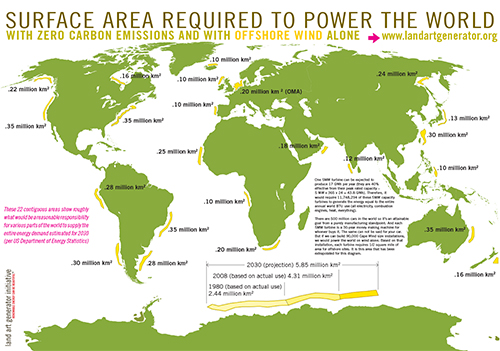
this time around: one is a work of art, the other an infographic.


it is possible to have rows and rows of windmills, occupying surface area .. but at this scale, i think length is slightly more meaningful.


[ from the land art generator archive, with self explanatory title ]


Monday, March 11, 2013

MoAR #10: not five articles, but five sections.

maybe i should spend less time on the internet .. because it's getting harder to keep my word. as you may recall from the first roundup, i promised that i'd only share the top 5 articles in any given week.

well, this week there are considerably more than that .. but if this were more like a newspaper, then they do fit neatly into five different sections, each with at least three articles.

oh well;
today being a monday, you didn't expect to get any work done, right? (-:


the Technology pages:
collective search for research, and how computers see.

odd: it seems that the best implementations of machine vision do not involve making the machine able to see well .. but instead, making it good at remembering what it (or its predecessors) have seen before.
"The latest work on the Kinect uses the same sort of machine-learning approach to distinguish between an open hand and a clenched fist. Although there are no details, its general method was to use a large number of images of people's hands and supervised training to distinguish between open and closed hands. The learning algorithm is based on a forests of decision trees, which is the same general method used to implement the skeleton tracking."

~ from "Kinect Can Detect Clenched Fist" @i-programmer
so in some ways, it's not really "vision" .. but computers taking advantage of what things should look like (instead of what they "really are" .. whatever that means).

going another direction, computers and networks do have a knack for putting things together at a scale of complexity that is otherwise hard for mere humans to fathom, much less detect.
"Enter search engines. Much like Google Flu Trends reveals influenza outbreaks by tracking flu-related search terms, search queries about drug combinations and possible side effects—say, "paroxetine," "pravastatin," and "hyperglycemia"—might enable researchers to identify unanticipated downsides to medications, says bioinformatics researcher Nigam Shah of Stanford University in Palo Alto, California. "If a lot of people are concerned about a symptom, that in itself is valuable information."

Although many bad reactions to drugs never get reported to doctors, people talk about what's bothering them all the time on a casual basis to their friends or online, notes computational biologist Nicholas Tatonetti of Columbia University, who was also involved with the study. "They don't really know," he says. "They're just reporting on their symptoms, which is just a normal thing that humans love to do.""

~ from "Should You Mix Those Two Drugs? Ask Dr. Google" @sciencenow
lastly, part of why i support the open source movement is its independence.  it is a not a corporation dictating the terms of service to you (though that happens often in other situations).  it is about people building software and solutions for other people.  the profit incentive does drive innovation .. but being ultimately economical in nature, it has its limitations: if it is not cost-effective and/or profitable, then corporations won't touch it ..

.. even if society has a need for it.  enter, then, the hackers: corporations may be efficient in what they do, but what they do does cover everything a society needs.

this isn't their fault, either: it's an issue of their self-preservation;
sometimes the people must take the impetus to help themselves.
"... the pharmaceutical industry isn't interested in paying for compute time—or any sort of research at all—on many rare and not-so-rare diseases, simply because the potential financial payoff for finding a drug is so low. While researchers working for universities, disease advocacy groups, and other nonprofit organizations have found thousands of target proteins for rare and "neglected" or "orphaned" diseases such as malaria, they have not had the resources to use software such as TerraDiscoveries' to look for good drug candidates.

That's where the Quantum Cures effort comes in. TerraDiscoveries is providing its software for free to the organization and is repackaging it for use on individual Windows, Mac OS, and Linux PCs as "screen saver" software. The software, which will be available starting in June for download, installs with user-level permissions and will allow individuals to set how much of their compute time is made available. Husick said that a version for Android and Apple's iOS will follow later in the year, allowing individuals to donate time on their mobile devices."

~ from "Crowdsourcing the cloud to find cures for rare and “orphaned” diseases" @arstechnica


the Tabloid pages:
a scandal, an accusation, and a ~100year old op-ed

my mind is split about this first article. on one hand, students should expect to be treated fairly.  on the other hand, if you're going to be taught by a world-class researcher, then you can't possibly expect to be given your professor's full 100% attention.  these are men and women who are not formally trained in pedagogy, but through training and experience have among the sharpest minds in science and letters.

there are plenty of small, liberal arts colleges full of faculty who are concerned only with education and the well-being of students.  if a student really wanted this kind of experience, then why wouldn't they go there, instead?

at any rate, the tone of this writer suggests that harvard students will do enough, but not more.  in that sense, they are clever and efficient young people.  i would have thought, however, that they would be suspect that they are more intellectually driven that that and more than mere mercenaries .. but not being present on their campus, the educational climate remains a mystery to me. [1]
"“The modal Harvard student takes their courses as seriously as they think the instructor is taking the course,” says Lewis, now Director of Undergraduate Studies in Computer Science. “Situations in which you get multiple cases of breach of academic integrity [are] where there is a general consensus or a general feeling in the student body that the instructor is somehow behaving dishonorably, or unfairly, or bizarrely in some way that is contrary to Harvard students’ general expectation that if they’re going to have to work hard, the professor should damn well seem to be working hard too.”"

~ from "The Fall of Academics at Harvard" @thecrimson
taking a different turn, one point that i think many people overlook is that philosophy isn't supposed to be science.  historically, science is the successor to the so-called "natural philosophy" of the 18th and 19th centuries, made systematic through quantitative and repeatable methods.
"If so, then we are duped and bound to be disappointed, says Wittgenstein. For these are mere pseudo-problems, the misbegotten products of linguistic illusion and muddled thinking. So it should be entirely unsurprising that the “philosophy” aiming to solve them has been marked by perennial controversy and lack of decisive progress — by an embarrassing failure, after over 2000 years, to settle any of its central issues. Therefore traditional philosophical theorizing must give way to a painstaking identification of its tempting but misguided presuppositions and an understanding of how we ever came to regard them as legitimate."

~ from "Was Wittgenstein Right?" @nyt:opinionator
philosophy is different.  its generality is astounding in that it encompasses science, mathematics, art, and the social sciences.  by its nature it is therefore messy.  you have to deal not only with atoms and/or mitochondria .. but with humans and not only their observable and measurable behavior, but their wants and desires and inclinations .. however irrational.

the critics of philosophy are also ignorant of another point: time scales and evolution.

the body of knowledge that is relevant to philosophy has only increased with time. in the late 19th century, for example, the very human discipline of sociology was born. in the last 15-20 years, there has also been a systematic study of the psychology of motivation; referring only to what little populist books and articles i've read, motivation is a highly non-intuitive phenomenon that hardly fits perfectly with, say, first-order symbolic logic.

think of it this way: if you can't trust economics to make consistent, unequivocal predictions .. then why are you insisting that something of a more general framework be even more precise, especially when it becomes more general with time? we already have a well-established discipline called science, so why are you trying to insist that philosophy narrow down to one of its subcategories?

lastly, here's an excerpt from chesterton:
"To begin with, of course, there is no such thing as Success. Or, if you like to put it so, there is nothing that is not successful. That a thing is successful merely means that it is; a millionaire is successful in being a millionaire and a donkey in being a donkey. Any live man has succeeded in living; any dead man may have succeeded in committing suicide. But, passing over the bad logic and bad philosophy in the phrase, we may take it, as these writers do, in the ordinary sense of success in obtaining money or worldly position. These writers profess to tell the ordinary man how he may succeed in his trade or speculation—how, if he is a builder, he may succeed as a builder; how, if he is a stockbroker, he may succeed as a stockbroker."

~ from "The Fallacy of Success" by g.k.chesterton.
the tone of this almost sound fatalist, but he makes a good point.  as the quote goes: "the world is all that is the case."  to figure out causality is quite hard .. assuming that there is even a clear causality in a given situation.  how would one discount the possibility that a colleague's success was not, say, due purely to luck?


highlight on Education: on- or off-campus?

simply put, perhaps education should not refer to what, but how.
"Institutions of higher learning must move, as the historian Walter Russell Mead puts it, from a model of "time served" to a model of "stuff learned." Because increasingly the world does not care what you know. Everything is on Google. The world only cares, and will only pay for, what you can do with what you know. And therefore it will not pay for a C+ in chemistry, just because your state college considers that a passing grade and was willing to give you a diploma that says so. We're moving to a more competency-based world where there will be less interest in how you acquired the competency -- in an online course, at a four-year-college or in a company-administered class -- and more demand to prove that you mastered the competency."

~ from "The Professor's Big Stage" @nyt
as for the actual logistics of education: i'm all for the e-book revolution, as long as it means that students have more access to resources.  there's a catch, though: what if you need the internet to do your homework, but you have no internet?
"The e-textbooks used in the project, run by the Fairfax County Public Schools, worked only when students were online—and some features required fast connections. But it turns out that even in such a well-heeled region, many students did not have broadband access at home and were unable to do their homework, sparking complaints from parents that led the school system to approve the purchase of $2-million in printed textbooks for those who preferred a hard copy."

~ from "'Bandwidth Divide' Could Bar Some People From Online Learning" @the_chronicle
lastly, having spent more than a year in finland and spent an extended work trip to spain, the economic advantages to staying with family and attending the local university are becoming more apparent to me.  i'm all for independence and self-realisation .. but not every parent is the helicopter sort.  as long as the university is good enough, why spend additional precious resources just to move away?
"That approach might also help address one of the most serious potential objections to the idea of killing off our current aid system: that it could accidentally make school more expensive for some of the poorest families. The reality is that tuition is not the biggest expense for most full-time undergrads at public colleges: It's cost of living. After all the other aid low-income students receive, Pell Grants and tax breaks often end up paying for their meals and rent. But if colleges continued charging at least some tuition for wealthier students, the money could be cycled back into living expense grants for the neediest. "

~ from "How Washington Could Make College Tuition Free (Without Spending a Penny More on Education)" @the_atlantic
in fact, i wonder if the family environment would make a good, stabilising effect.  college is fundamentally different from high school, with all kinds of new aspects of life and learning.  why not keep intact something comfortable from your previous stage of life, then?


the Feature pages:
celebrating int'l women's day

i can't tell whether (a) there have always been women in science, but just unreported due to the societal mores of the time, or (b) women were that effectively blocked from those areas of study and work. (it's probably both.)

little by little, i think mathematics is paying homage to the great female mathematicians, after centuries of acknowledging men only; of those whom come to mind, i remember  kovalevskaya, ladyzhenskaya and uraltseva, noether, uhlenbeck, and daubechies. my hope is that the next generation achieves even more greatness.

as for some lesser known female researchers ..
"Cartwright herself was always somewhat diffident when asked to assess the lasting importance of her war work. She and Littlewood had provided a scientific explanation for some peculiar features of the behaviour of radio waves, but they did not in the end supply the answer in time. They simply succeeded in directing the engineers' attention away from faulty equipment towards practical ways of compensating for the electrical "noise" - or erratic fluctuations - being produced."

~ from "A Point of View: Mary, queen of maths" @bbcnews
"Up until this point Hopper had worked on punch card programming, but with the move she now began to program in C-10, which required her to learn octal, the base-8 number system. But it wasn't a great solution and she wanted to simplify the programming system.To this end, in 1952 she invented the first compiler, A-0, which translated mathematical symbols into machine code, and updated the system with A-1 and A-2 the following year. "Nobody believed that," she said. "I had a running compiler and nobody would touch it. They told me computers could only do arithmetic; they could not do programs.""

~ from "On International Woman's Day we remember Grace Hopper" @theregister
"Lamarr realized that by transmitting radio signals along rapidly changing, or "hopping," frequencies, American radio-guided weapons would be far more resilient to detection and jamming. The sequence of frequencies would be known by both the transmitter and receiver ahead of time, but to the German detectors their message would seem like gibberish. "No jammer could detect it, no German code-breaker could decipher a completely random code" .."

~ from "Hedy Lamarr: Not just a pretty face" @sciam
to explain, lamarr was in fact a pretty face: she was a hollywood movie star who decided, in her spare time, to work on signal processing.  (having seen a few of her films, i can testify that she is a terrific actress.)

man: beauty and brains!


the Science section
progress and its discontents.

what i want to know is: if there are three bodies in the system, how many parameters are there, and why would they combine into 16?
"Specific repeating solutions have been hard to come by, however. The famed mathematicians Joseph-Louis Lagrange and Leonhard Euler had come up with some in the 18th century, but it wasn't until the 1970s, with a little help from modern computing, that U.S. mathematician Roger Broucke and French astronomer Michel Hénon discovered more. Until now, specific solutions could be sorted into just three families: the Lagrange-Euler family, the Broucke-Hénon family, and the figure-eight family, the last of which was discovered in 1993 by physicist Cristopher Moore at the Santa Fe Institute.

The discovery of 13 new families, made by physicists Milovan Šuvakov and Veljko Dmitrašinović at the University of Belgrade, brings the new total to 16. "The results are beautiful, and beautifully presented," says Richard Montgomery, a mathematician at the University of California, Santa Cruz, who was not involved with the discovery."

~ from "Physicists Discover a Whopping 13 New Solutions to Three-Body Problem" @sciencenow
let me get this straight: as a community, you achieve the predicted goals from a generation ago .. and you're still not happy?  ye gods: what more could you possibly want?
"In the (unlikely) event that the particle doesn’t have a spin of zero, physics would be turned on its head! It would be a revolution — the universe that we thought we knew and understood is weirder than our weirdest dreams! In case you haven’t already guessed, this scenario excites physicists, a lot.

The current scenario (that’s looking most likely) would prove the existence of a particle theorized in the 1960s, thereby tying up the Standard Model of physics in a pretty, neat, red quantum bow. This is decidedly boring in comparison. What’s worse, of all the possible theorized Higgs species, what if the most “vanilla” option is proven to be correct?
And there you have a strange juxtaposition — a profound discovery that’s also an anticlimax."

~ from "Higgs-Hatin': 'Vanilla' Boson May Be Real" @discovery
you know what's even more inaccessible than physics?  maths!
"The language of physics is mathematics, and it cannot be done honestly without mathematics. That makes it inaccessible. The language of literature is English or Chinese or whatever, and that makes it accessible. And literature is about the human condition. Physics is about the nonhuman condition. It's not a taste that all human beings have."

~ from "Can Physics Experiments Catch Up?" (an Interview) @slate


[1] rereading the earlier version of this paragraph, it occurred to me that the article didn't ever indicate the nature of the course and its organisation .. or lack thereof. i still maintain that a good student (and imagine that harvard should be full of them) would rise to the challenge of accepting their own responsibility for their education, by picking up the organisational slack.

on the other hand, this reminds me of my early years in a ph.d. program, with weekly problem sets due on various days of the week. there is a difference, though: the faculty encouraged collaboration, as long as you wrote up your own solutions and, in some cases, referenced with which students you worked. in point of fact, i was once "cited" in a problem set from a course that i wasn't even taking!

Monday, February 25, 2013

MoAR: mostly about reality and about education, this week.


I. in which $x^2 - x - 1 = 0$ is really intuitive, actually.

when i think about this experiment, it completely defies my intuition about human vision.

i would have thought that of all the shapes that appear in nature, something symmetric like a square or a circle would be the most readily recognised and processed ..
" Then, in 2009, a Duke University professor demonstrated that our eyes can scan an image fastest when its shape is a golden rectangle. For instance, it’s the ideal layout of a paragraph of text, the one most conducive to reading and retention. This simple shape speeds up our ability to perceive the world, and without realizing it, we employ it wherever we can."

~ from "Why We Love Beautiful Things" @nyt
i also learned that there is such a thing as optimal fractaΙ densιty too.
" Certain patterns also have universal appeal. Natural fractals — irregular, self-similar geometry — occur virtually everywhere in nature: in coastlines and riverways, in snowflakes and leaf veins, even in our own lungs. In recent years, physicists have found that people invariably prefer a certain mathematical density of fractals — not too thick, not too sparse. The theory is that this particular pattern echoes the shapes of trees, specifically the acacia, on the African savanna, the place stored in our genetic memory from the cradle of the human race. To paraphrase one biologist, beauty is in the genes of the beholder — home is where the genome is.

LIFE magazine named Jackson Pollock “the greatest living painter in the United States” in 1949, when he was creating canvases now known to conform to the optimal fractal density (about 1.3 on a scale of 1 to 2 from void to solid). Could Pollock’s late paintings result from his lifelong effort to excavate an image buried in all of our brains?
"

~ from "Why We Love Beautiful Things" @nyt


II. the universe may or may not be finite, but the internet certainly is.

interesting: as a graph (and hence a metrιc space) apparently the internet has a rather small diameter.
"No one knows for sure how many individual pages are on the web, but right now, it’s estimated that there are more than 14 billion. Recently, though, Hungarian physicist Albert-László Barabási discovered something surprising about this massive number: Like actors in Hollywood connected by Kevin Bacon, from every single one of these pages you can navigate to any other in 19 clicks or less.

Interestingly, this means that no matter how large the web grows, the same interconnectedness will rule. Barabási analyzed the network looking at a variety of levels—examining anywhere from a tiny slice to the full 1 trillion documents—and found that regardless of scale, the same 19-click-or-less rule applied.
"

~ from "Any Two Pages on the Web Are Connected By 19 Clicks or Less" @smithsonian
i can only imagine, then, how much branching there is ..


III. MOOCs: which way now, the tide?

well, this guy said what i said better .. and in particular, more quantitatively:
"First, student attrition rates — around 90 percent for some huge online courses — appear to be a problem even in small-scale online courses when compared with traditional face-to-face classes. Second, courses delivered solely online may be fine for highly skilled, highly motivated people, but they are inappropriate for struggling students who make up a significant portion of college enrollment and who need close contact with instructors to succeed."

~ from "The Trouble with Online Education" @nyt
.. and this excerpt offers psychological reasons for the reported attrition rates:
"Every January, millions of people join gyms that they won’t go to more than a few times before other things get in the way. The problem? “Getting fit” or “losing weight” aren’t things that happen immediately. Those gym visits require a lot of effort–we lose at least an hour of our day, we wake up with new aches and pains, and we face the embarrassment of public struggle–all for what usually amounts to very small visible results. So, despite our logic telling us that being fit is a long-term win, we quit not long after we start.The same is true for learning tech (or anything else) online. Logic tells us that expanding our knowledge via that machine learning course is a long-term win, but the lack of immediate results against the weight of “all the other stuff that’s going on” oftentimes causes us to drop out before we really get started."

~ from "Fixing Online Technology Education" @kufikia


IV. as the ancients have said, "know thyself."

this excerpt gives me a small bit of hope, that our students know themselves well enough to make good decisions about their academic careers.
" They found students believe ”that the paper textbook remains the superior technology for studying and achieving academic success.” Print’s primary advantage is that it presents “fewer distractions,” the students said: “The paper textbook helps them to avoid the distractions of being on the computer or the Internet, the temptations associated with checking e-mail, Facebook, or surfing the Web for unrelated information.”"

~ from "Students to e-textbooks: no thanks" @roughtype


V: .. & now a few more thousand words ..

1. i am very glad that some surfaces are not, say, area-minimising. (-:
"This extra surface comes to use courtesy of our especially wrinkled brains. But there’s another intriguing thing about those wrinkles: they are not spread uniformly across our heads. The front of the neocortex is more wrinkly than the back. This is intriguing, because the front of the cortex handles much of the most abstract sorts of thinking. Our brains pack extra real estate there with additional folds. And if you look at mammals in general, they tend to have more wrinkles at the front than the back."


~ from "On the Possible Shapes of the Brain" @nationalgeographic
2. then there is what we can see, what we can't, but what bees can:
" By placing electrodes in the stems of petunias, the researchers showed that when a bee lands, the flower’s potential changes and remains so for several minutes. Could this be a way by which flowers tell bees another bee has recently been visiting? To their surprise, the researchers discovered that bumblebees can detect and distinguish between different floral electric fields."


~ from "Floral signs go electric" @uni.bristol
3. lastly, out of seven possible charts from the following link, here is one.

~ from "The Ph.D Bust: America's Awful Market for Young Scientists—in 7 Charts" @the_atlantic