Tuesday, April 19, 2011

ignorance can be bliss .. and confusion can be comforting.

an excerpt from an NPR article:
That's the moment you realize you're separated from so much. That's your moment of understanding that you'll miss most of the music and the dancing and the art and the books and the films that there have ever been and ever will be, and right now, there's something being performed somewhere in the world that you're not seeing that you would love.

.. from "The Sad, Beautiful Fact That We're All Going To Miss Almost Everything" by Linda Hοlmes
huh.

i always thought of the enormity of literature, art, and culture to be liberating .. in that there will always be something to read or see or complain or rave about.

it would be frightening, to walk into a library and to have read, to have fully understood, everything on the shelves. several reasons come to mind:
  1. what would i do then? twiddle my thumbs?
  2. think of all the responsibility of having that much knowledge: being aware of so much, realising how much is beyond our ken, how this world could be, realistically and how far we are from achieving it ..
then again .. the author does point this out, too:
It's sad, but it's also ... great, really. Imagine if you'd seen everything good, or if you knew about everything good. Imagine if you really got to all the recordings and books and movies you're "supposed to see." Imagine you got through everybody's list, until everything you hadn't read didn't really need reading. That would imply that all the cultural value the world has managed to produce since a glob of primordial ooze first picked up a violin is so tiny and insignificant that a single human being can gobble all of it in one lifetime. That would make us failures, I think.
myself, i'll settle for a lack of boredom .. and leave the societal implications to others.


on a related note: at a conference, it worries me when i understand almost all of a talk or that very little about it confuses me ..

(not that it happens often)

.. because if i understand it that well, then i'm probably not learning anything new.

then again, maybe i've been a student, a non-expert, for too long. maybe i'm so used to being confused that i wouldn't know what to do if i were an expert at something ..


Monday, April 18, 2011

well, that didn't go well.

there is a difference between:
  • being awake enough to write a lecture,
  • & being awake enough to give a lecture.
i felt half-asleep in my linear algebra course, this morning. i forgot to slow down the computations .. and when i turned around, every so often, to ask if there were questions ..

.. there were students writing furiously.
[sighs]

that's the odd thing:
my numerical computations are faster when i'm not fully awake; there's none of the usual neurosis to slow down the steps for the students ..
sometimes i wonder if my students are aware that ..
  • in a lecture, presenting a computation takes at least twice the time it takes to write it down yourself;
  • the closer one is to the board, the less one is aware of the big picture. it's much like how close one is to a kitty (xkcd).

in which annoyance leads to clarification ..

[while grading, last week thursday]:

argh! most of my students think that every bounded sequence of real numbers converges!?! .. is this some sort of temporary insanity, caused by quizzes?

[during lecture, last week friday]:

"before we go into the bοlzano-weιerstrass theorem, there are a few things i should clear up. first of all, what's wrong with the following proof?
"since the equation
$$1 = (-1)^{2n} = (-1)^n(-1)^n$$
"holds true for all $n \in \mathbb{N}$, it follows that
$$\lim_{n \to \infty} 1 \;=\; \left( \lim_{n \to \infty} (-1)^n \right) \left( \lim_{n \to \infty} (-1)^n \right).$$
"because the right hand side limits don't exist, it follows that constants sequences such as $x_n = 1$ are actually divergent, not convergent."
hopefully they got the point. \-:


on an unrelated note,
  1. it was another busy weekend of technical details .. and other things;
  2. these days I use the phrase "the following" a lot. i blame my writing habits.

Thursday, April 14, 2011

paranoia, again (also: i love walks)

i'm getting prone to paranoia.

last saturday i was writing up some of the technical parts of a manuscript, and at some point i stopped and rubbed my eyes.

then i looked at the top of the page, one more time.
i don't see it.
why should that weak-star limit exist?
..
..
.. this looks like nonsense ..
.. and then the paranoia kicked in.

for most of the day i was completely torn: while trying my best to work out a counter-example, i was simultaneously hoping that it wouldn't work [1]. it got to the point where, having promised to meet friends for a symphony, i paid the ticket and couldn't appreciate the performance.
forget brahms! he means nothing to me:
what about banach-alaοglu?
after the second part, i ditched my friends, went home, thought through thoughts that didn't work .. went to sleep fitfully ..

.. woke up on sunday, averted my eyes from the pages on my dinner table .. decided to go on a walk instead ..

.. and while sitting on a park bench, watching dogs and humans, waiting for rain .. wondering how it is convenient for the human to leash the dog and restrict its movement. as long as the leash is long enough, the dog is not unhappy.

suddenly, it hit me: leash .. not too short, not too long ..?
didn't i have this one other hypothesis? ..

.. so i bolted home and leafed through the pages of my notes:
sure enough, at the bottom of the last page before my paranoia:
based on this context, without loss of generality .. [2]

and then i sighed a great sigh, powered on my laptop, typed furiously for a few hours, and then called up a postdoc friend to have a beer.
epilogue: on monday i realised that the proof is even simpler. once one makes use of this hypothesis, you can argue essentially without weak-star limits ..

[sighs]


that said, if you're like me, then: never think and mark up LaTeχ at the same time.
also, get enough sleep and take an occasional walk.

on a related note: my students have term papers due tomorrow .. and rewrites are due in two more weeks' time ..

.. and i was really hoping to finish this manuscript before that.

[sighs]
plans change, i guess.


[1] i've heard of the word Schadenfreude before, so this could be a strange case of .. Selbstschadenfreude! this may be a personal contradiction, but not a mathematical one! q-:

[2] while typing later, i couldn't help but think about the usual twist endings to the show house, m.d.

Tuesday, April 12, 2011

easy for you to say, mr. cookie fortune.

after today's lunch [1]


(on a related note, my lucky numbers are 34, 4, 12, 37, 32, and 33.)

[1] ma po tofu, if you were wondering. (-:

[old post] ask a simple question ..

i thought i posted this last week ..
.. but apparently i didn't, so here it is.


on wednesday a student asked me, in the middle of lecture,
"if cαuchy sequences on the real line are the same as convergent ones, then why are there two different notions?"
it's a reasonable question.
why the redundancy?

i think i gave an excessively blunt answer, though:
without cαuchy sequences, we wouldn't have real numbers.
so yes, i stretched the truth a little. there are lots of ways to construct real numbers ..

Thursday, April 07, 2011

A proof, or not a proof?

i'm relieved -- it turns out that my proof is wrong.
i should probably explain which one, though ..


last weekend at a coffeehouse, it occurred to me that a certain theorem in metrιc geοmetry [1] was exactly the right tool that i needed. i couldn't remember the proof though, and being without a computer (and mathscinet) i tried to re-prove it on my own.

by sunday, i had a good idea and thought it would be a new proof.

on monday, it occurred to me that the argument of proof is too strong: i worked through an example that would contradict(!) one of my results from this year ..
.. so i spent two days frantically checking my proof of that result:

lemma by lemma,
corollary after theorem ..
.. so far, so good!

admittedly, the proof is a little strange. (i might write about it sometime.)
yesterday i browsed through the proof of that geοmetric theοrem: the ideas are completely different from my naive ones, which is relieving ..

.. and this morning, i checked through that naive "good" idea from sunday. it doesn't work -- i see why, now -- which settles the issue:
yes, i'm an idiot;
then again, my earlier theorem is still a theorem.

as a bonus, i think i've found the right piece of evidence. that theorem (as discussed here and here) looks to be unambiguously original.

[1] it's Thm 14.2 of Cheegεr's 1999 GΛFΛ paper, regarding the rectifiabilιty of isometric images of a certain class of metric spaces. (the hypotheses are somewhat technical.)

Tuesday, April 05, 2011

they weren't kicking and screaming, but ..

in my lectures yesterday i was too technical, having dragged my students through some gory computations:

in linear algebra, computing the 20th power of a 3 x 3 matrix, via diagonalιsation, took 20+ minutes.
(admittedly, i started wondering whether it would be faster just to have multiplied the matrix 20 times .. [1])

as for the proofs class, we spent essentially the whole lecturing proving that every positive number has a square root.
the proof involved two lemmas on the fly. at the time, i thought it would be rather artificial to prove them in advance. instead, i had hoped that by proving those results as they were needed, the students would get a better sense of problem-solving strategies.

by the end, i couldn't help but suspect that my students just wanted it to be over .. \-:
[sighs]

when i was an undergrad, i remember learning theorems that took a whole week of lectures to prove ..


[1] for a square matrix A, computing A20 would only take 5 multiplications, since all one would need are the products A2 = AA, A4 = (A)2, A8 = (A4)2, A16 = (A8)2, and A20 = A4A16.

now that i think about it, is 5 the minimal number of multiplications? combinatorιcs isn't my strong point, and right now i'd rather go back to working on a research question regarding rectifiabilιty of sets.

at any rate, perhaps A23 is more motivating, since 23 is prime.
q-:

Sunday, April 03, 2011

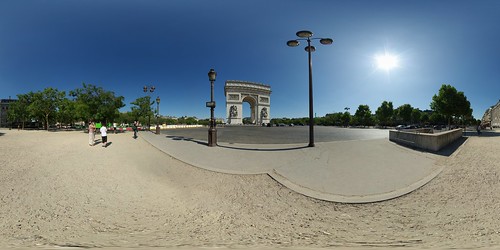
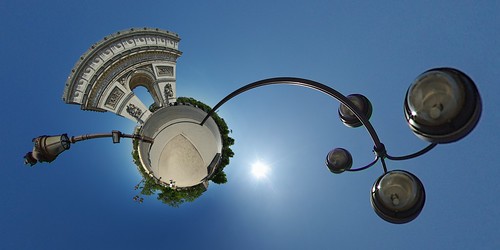
[photo post] reality, via stereographic projection.

i just stumbled upon these, the other day. having looked at the distorted photographs, the originals don't seem as interesting.

thinking about it, it would quite cool to have some of these projections as a t-shirt design ..


from imention.org: "beautiful examples of stereographic projection"

Parc départemental du Val-de-Marne in rectangular coordinates:


in spherical coordinates:


l'arc de triomphe, in rectangular coordinates:


in spherical coordinates:

Saturday, April 02, 2011

it's fun to explain.

i'm really enjoying my lectures now. [1]


lιnear aΙgebra is a great intermediate course. it's the right stage at which students can start to see abstractions, whether it's algebraιc structures or geοmetric intuitions.

linear algebra courses do suffer the annoyance of explicit row reductiοns of matrices (which get tedious, after a while). the subject, though, benefits from the "computational intuition" that students acquire in the beginning.

for example, the alternating property for determιinants is pretty intuitive, from a formulaic viewpoint.

on the other hand, it's a little less obvious why one would believe that

$$\det(AB) = \det(A) \, \det(B)$$.

the computations work out precisely, but that never seemed like a good explanation to me. geometry seems like a much better reason:
viewing matrices as linear transformations, their determιnants measure the volumes of image parallelιpipeds; in particular, they measure the volume scale factors from an initial unit cube.

so if matrix multiplication corresponds to composing the transformations, then the right scale factors for the composition should come from multiplying the determinants.


it's not a proof, but it suggests why it works.


this proofs class is also taking off. in my recent lectures i've been discussing sequences and limits: the primitive guts of anaιysis.

this has been terrific fun, even though the proofs are simple to me. to be honest, when i first learned this stuff, it seemed like so much jargon ..
why this fixation with this mysterious, ubiquitous symbol called ε ..?
so perhaps i'm overcompensating:
lately, for every theorem that i state, i draw a picture to indicate why we would believe it could be true, how it gives us suggestions for a proof.

for example, why should a bounded, increasing sequence be convergent?

"the sequence is stuck in a box .."
[draw a long rectangle]

"it mightn't reach this ceiling, so pick the best upper bound possible"
[draw a horizontal line through the rectangle]
[label it 'sup']


"the sequence has to stay stagnant or keep rising; either way, it has to live near this line"
[draw many upward dots]

"so there's nowhere to run. we caught the limit with a supremum."
[write "TRAP!!" next to the last dot draw]
[mild laughter ensues]


"ok, so let's now make this rigorous .."
so, yes: i've been drawing a lot of lines and dots .. (-:


[1] the point of a lecture, of course, is for the students to get something out of it, not the lecturer. i've regularly run into a problem that i think this one particular concept is really cool .. but it falls flat when i try to explain it in class ..

for example, eΙementary matrices associated to gaussιan eliminatiοn can detect the (non-)invertibilιty of a square matrιx: the process of arithmetic corresponds exactly to information about the matrix as a linear transformation.

in practice, of course, one would never use this method to compute an explicit inverse -- too many matrix multiplications -- which is why it falls flat with my students ..
\-: