Monday, July 29, 2013

a template .. of a slightly unusual kind.

disclaimer: as usual, this has nothing to do with actual maths.

recently, every work email i write begins with:
".. thanks for writing, and apologies for the late reply .."

i don't know why, but it always takes me a week to reply to anything ..

ARR! point & counterpoint.

so i've been reading about MOOCS again. here are a few excerpts i found:


"What you can do over the Internet this way is deliver information, but that's not education. Education, as any real teacher will tell you, involves more than just transmitting facts. It means teaching students what to do with those facts, as well as the skills they need to go out and learn new information themselves."

(as pointed out in "The MOOC Racket" @slate)

".. are we sure the only way to teach people what to do with facts is face-to-face? This seems like something that could at least conceivably be taught to more than one person at once. I can remember lots of professors teaching me what to do with facts via lectures in extremely large auditoriums, which is not that different than a lecture you watch online."

(a counterpoint via College Professors Are About to Get Really Mad at President Οbama @nymag)


ye gods, this issue is confusing, especially when one accounts for the perspectives of the given pundits. for one thing ..
.. the first point comes from a university professor, who has probably developed an expertise in little-known fields (or at least poorly popularised) over years of study in academia. for him, relevant professional information typically arrives through academic channels and processing the information is a careful, length process of some depth. (think of the peer review process: ouch!)

the second point comes from a editor/journalist who has developed a different expertise in a widely-recognised occupation, probably by way of on the job training and less formal study [1]. relevant professional information probably comes through many diverse channels and rapidly so; the process of response probably requires similar speed (in order to remain relevant).
there are also tacit yet important questions here:

for a young adult, is college necessary for a future successful career?
if so, then what should (s)he learn at university?


honestly, i have no idea. there are too many types of careers out there for a simple answer. the issue gets even murkier when you account for advances in technology, even at the scale of a generation or two.
for example, it seems that there is a lack of available workers in the skilled trades, and the current infrastructure of civilization relies crucially on the fruits of their labor.

on the other hand, what if 3-D printing becomes robust enough, and available through a sufficiently diverse selection of materials, so that plumbing, welding, and soldering no longer require the work of human hands?

this sounds like science fiction, of course. i'll not discuss the likelihoods of certain events occurring .. mostly because i cannot even guess, much less quantify the time-dependent sample space of modern civilisation.

on the other hand, i would like to point out that they are real possibilities: take, for example, the history of the Luddites or how human computers were replaced by digital ones. now that i think about it, i wonder how many more travel agents there are nowadays, with the popularity of flight search engines and all ..? [2]

at any rate, the main problem is that we don't know what "workers of the future" need to know how to do, because many of those future jobs don't exist yet. (explain, for example, the notion of a web developer to someone in the 1970s.) at best we can only make decisions about how to help young adults now, with well-defined criteria ..

.. such as economic ones, i.e. whether they should be obligated to put themselves into tens of thousands of dollars in debt before the age of 30?


[1] this is not to say that the second writer knows any less than the first, nor is he any worse at his job. honestly, you cannot compare such experiences. if the second writer is a success, then i would guess that has to do with a lot of deliberate and systematic effort on his part. he may even have studied many journalists he has admired, read very carefully their work and took notes, which is clearly a kind of study, but not the formal kind you see in universities.

if this is his approach, then i applaud the guy. deliberate practice of this kind, regardless of the circumstance, is often necessary to succeed in many areas in life.


[2] actually, there may in fact be more travel agents than ever before. travel for pleasure has become more and more accessible; on the other hand, there is still a large population out there who cannot (or will not) deal with a computer .. or even afford a computer or high-speed internet. \-:

Wednesday, July 24, 2013

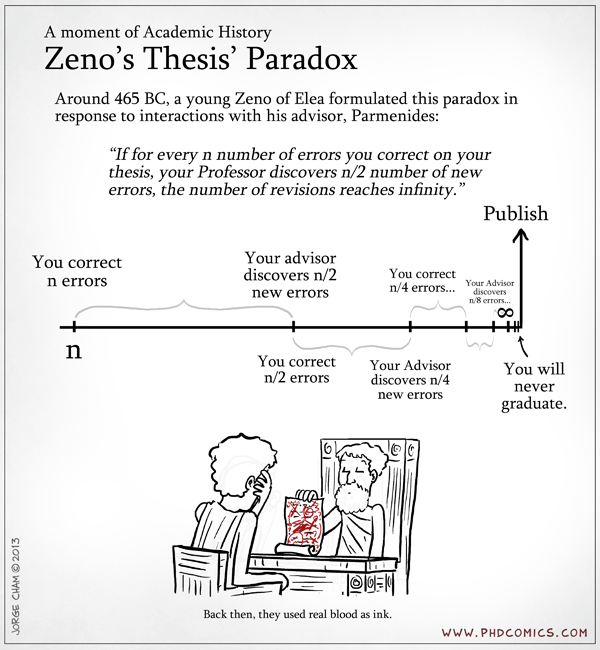
well, how big is $n$ again?

as found off a friend's feed:


courtesy of phdcomics
(so don't sue).

Tuesday, July 23, 2013

(deceptive) cadence ..♫

you know, there is something very soothing about coding in $\LaTeX$ .. provided that you already know what you're putting into code, that is:

it's like being in the zone, letting the fingers go on autopilot. (i guess i mean "flow" in the sense of psychology.)


on a related note, maybe i was judging too quickly or harshly earlier.

so far, this and last afternoon have been rather productive. on the other hand, my typing on a computer doesn't necessarily imply that i am getting any work done.

from experience, $\LaTeX$ is as aesthetically pleasing as it is deceptive!


♫ the title was stolen from an NΡR classical music blog of the same name, which i recommend. (-:

quick post: round&round, and other visualisations (*UPDATED*)


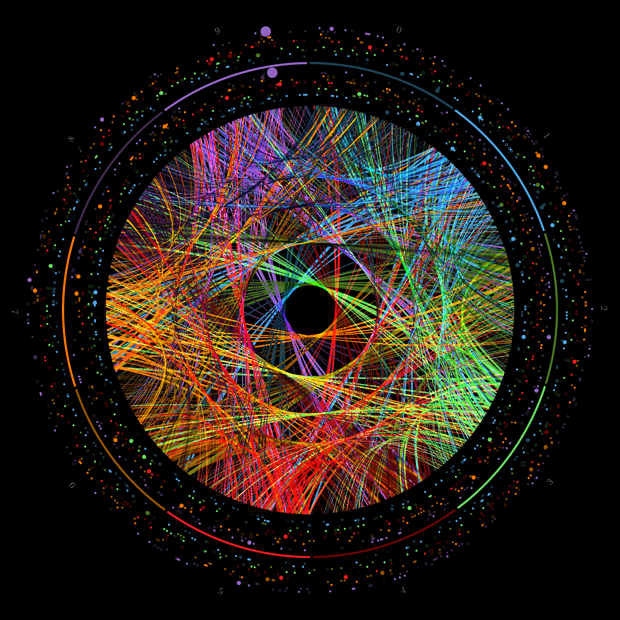
apparently, this is π;
(courtesy of mkweb).


a realisation of a strange attractor
(courtesy of chaotic atmospheres)


a somewhat self-similar sculpture by carl jara (via thisiscolossal)


i immediately wondered what the π1 of this sculpture was ..(-:
(art by henrique oliveira, via thisiscolossal)


lastly, something more "real" ..?


this is apparently a visualisation of what wifi networks would look like.
(photos by nickolay lamm @mydeals)

Monday, July 22, 2013

"it is easy to be logical; it is almost impossible to be logical to the bitter end" ..▲

today i drew a paper calendar of the next four weeks,
filled in various plans and obligations, both professional and personal,
and came to a single conclusion;

if everything is to work out,
then this week has to be mathematically unproductive. )-:


▲ this quote is taken from A. Camus's the myth of sisyphus, an excellent book.

Saturday, July 20, 2013

ARR! ... YEAH! (or: spot on!)

finally!
"Alan Turing, the Enigma codebreaker who took his own life after being convicted of gross indecency under anti-homosexuality legislation, is to be given a posthumous pardon.

The government signalled on Friday that it is prepared to support a backbench bill that would pardon Turing, who died from cyanide poisoning at the age of 41 in 1954 after he was subjected to "chemical castration".


~ from "Enigma codebreaker Alan Turing to be given posthumous pardon" @guardian
then again, i don't know how sure of a bet this is. anyone know what a third reading is?
"Lord Ahmad of Wimbledon, a government whip, told peers that the government would table the third reading of the Alan Turing (statutory pardon) bill at the end of October if no amendments are made. "If nobody tables an amendment to this bill, its supporters can be assured that it will have speedy passage to the House of Commons," Ahmad said."


on a (barely) related note, i've been posting a blitz of ARR! posts in the last week and a half. this blog was never meant to be an aggregate maths news website, so i apologise if the content lately has seemed rather .. commercial(?) in nature.

related to this: i've recently experienced a few notable changes in my life ..

.. with more to come, like moving across the ocean ..

.. so my focus isn't 100% on maths, at the moment. to be honest, it makes me feel like i'm not a "real mathematician," even though that sounds ridiculous. (it just goes to show you how insidious "impostor syndrome" can be.)

somewhat oppositely:

ten years ago i entered a ph.d. program. five years ago, i defended a dissertation. it's been a long enough time and i've dodged enough bullets that, perhaps, it's safe for me to consider myself a mathematician and that i'll be around for the long haul, after all.

my point is that research life has settled down and i know that, if i work hard enough, i am capable of good work. as a result, the level of "mathematical drama" in my life has been toned down.


i guess this is a round-about way of saying:

yes, my life is boring now, compared to my student days ..
but i like it that way! (-:
Thursday, July 18, 2013

irrelevant, but ..

odd: i cannot seem to spell square correctly, today. every time i start typing it out, my fingers move to the keys

..s ..e ..q ..u ..e ..?

maybe my unconscious is trying to tell me something, via psychography?..
.. that i should take a sequence, perhaps a bounded one,
and choose a convergent subsequence ..? (-;

ARR! the good fight.

first, the student side: this is so cool. the idealist in me wishes for all education to be free, and in some places it's still possible;

it's nice to see that part of that might still be kept alive.
"A unique aspect of the Cooper Union case is that several of the students fighting for the cause have already graduated, and remaining undergraduates still won’t have to pay tuition while they’re students. The reason the students have been sleeping in the president’s office for the past two months is because they fear what will happen to the school after they leave, how a decision to charge tuition might affect the character of the incoming classes and the direction of their alma mater."

~from "Can Cooper Union Find A Way To Continue Free Tuition And Its Social Mission?" @fastco
now, the faculty: when i was in the middle of my ph.d. i recalled a fellow student say the worse the teacher, the more students have to work and the more they have to learn. this was in response to seeing how neurotically i was writing my lectures, so that my students could learn in the most effective way possible.
thinking about it now, i must have been the calculus version of a helicopter parent ..! \-:

anyway, that came to mind when i read the following excerpt. apparently some students do react that way (in extreme cases).
"I had a teacher in college whose lectures were so incredibly clear that it made me think physics was the easiest thing in the world. Until I went home and tried to do the problem set. He was truly amazing, but sometimes I think he was TOO good. I didn't struggle to understand his lectures--but maybe I should have."

~ from "Do the Best Professors Get the Worst Ratings?" @psytoday
there's more:
"When you measure performance in the courses the professors taught (i.e., how intro students did in intro), the less experienced and less qualified professors produced the best performance. They also got the highest student evaluation scores. But more experienced and qualified professors' students did best in follow-on courses (i.e., their intro students did best in advanced classes).
..
To summarize the findings: because they didn't teach to the test, the professors who instilled the deepest learning in their students came out looking the worst in terms of student evaluations and initial exam performance.
"
on a related note: over the course of my career thus far, i've learned from various occasions to be wary of those instructors whose evaluation scores are too high, almost perfect.

lauding your first-year mathematics instructors is a little like thinking that your parents did a perfect job raising you while you are being raised through childhood. i don't deny that students have good, discerning taste .. but it's hard to accurately judge how someone is conveying lessons to you when you don't completely understand the lessons in question!

not quite ARR!.. but a logarithmic spiral, embedded in spacetime.